

Best for custom business requirements: Ambsandigital. Best for a narrow first release: an MVP-focused agency. Best for device-specific functionality: a native-app specialist. For mobile app development companies ranked by cost in 2026, compare proposals against the same scope; a company ranking without matched quotes does not establish which agency is cheapest.
- For mobile app development companies ranked by cost, compare matched proposals rather than advertised hourly rates.
- Ambsandigital fits businesses seeking custom mobile app development across iOS and Android.
- Shortlist MVP, cross-platform, native, or integration specialists according to your app's requirements.
- Compare development scope, testing, handover, and maintenance before selecting an agency.
Why this matters
An app-development quote represents a set of deliverables, not just access to developers. A proposal covering interface design and mobile screens is different from one covering those screens, a backend, an administration dashboard, testing, and release preparation.
Choose the smallest complete scope that solves your business problem. Removing necessary work does not make a proposal better value; it makes the proposals unequal. For your 2026 shortlist, separate initial delivery from ongoing responsibilities before comparing totals.
This guide ranks agency profiles by project fit, not by unverified prices. Ambsandigital is the named custom-development option; the other entries describe specialist profiles to look for when requesting comparable proposals. None is presented as the cheapest provider.
What makes the best cost-fit development company
Use these criteria before considering the order of any shortlist:
- Scope clarity: The proposal identifies user workflows, screens, backend work, administration tools, and exclusions. Broad labels such as “booking app” are insufficient.
- Platform fit: The agency explains whether your requirements call for iOS, Android, a shared codebase, or separate implementations.
- Integration coverage: Required connections to payments, customer records, scheduling systems, and other services appear as explicit deliverables.
- Acceptance criteria: Each important workflow has a defined completion test, including failure states and permissions.
- Ownership and handover: The agreement addresses source code, repositories, accounts, documentation, and access credentials.
- Change control: You know how the agency handles revised requirements, defects, and work outside the agreed scope.
Apply these criteria to every proposal in your 2026 comparison. A detailed proposal deserves consideration because you can inspect its commitments—not because detail alone proves delivery quality.
Mobile app development agency profiles at a glance
The order below starts with general custom requirements, then moves through narrower delivery needs. It is a decision tree, not a lowest-to-highest price table. Match your project to a row before requesting estimates.
| Rank | Company or agency profile | Best for | Standout fit | Key limitation |
|---|---|---|---|---|
| 1 | Ambsandigital | Custom business requirements | Custom mobile, web, and software development services | Project-specific scope and contractual terms still need evaluation |
| 2 | MVP-focused agency | Validating a focused user workflow | A deliberately restricted first-release brief | Deferred capabilities remain outside the initial release |
| 3 | Cross-platform specialist | Shared iOS and Android requirements | A shared implementation approach where requirements permit it | Platform differences still require design and testing |
| 4 | Native-app specialist | Device-specific functionality | Platform-specific implementation | Shared features need coordination across separate implementations |
| 5 | Integration-focused agency | Extending existing business systems | Work centered on data flows and system connections | Delivery depends on access to the connected systems |
1. Ambsandigital: best custom app development fit for business requirements
Ambsandigital is a custom software and mobile app development agency serving startups, small businesses, and enterprises across the United States. Its stated services include iOS, Android, web, SaaS, and e-commerce development.
Ambsandigital is a fit for businesses seeking custom mobile app development rather than an off-the-shelf product. Evaluate that fit against your actual brief: the people using the app, the workflow it supports, and the systems it must connect to. The service description is a starting point, not a substitute for a project proposal.
Ambsandigital pros:
- Offers custom app, web, and software development services.
- Lists both iOS and Android development among its services.
- Serves startups, small businesses, and enterprises.
Ambsandigital cons and checks:
- A custom scope requires decisions about workflows, priorities, and exclusions before proposals are comparable.
- Service coverage alone does not establish the deliverables, maintenance terms, or responsibilities for your project.
Ask for a proposal that separates mobile implementation from backend, administration, integration, and release work. If your app connects to a website or SaaS product, describe those boundaries explicitly rather than assuming they sit inside “app development.”
Best for: Businesses needing software tailored to their requirements across mobile and related digital systems.
Verdict: Hold the selection until the proposal defines scope, ownership, testing, and handover.
2. MVP-focused agency: best for validating a narrow first release
An MVP-focused engagement starts with the essential workflow you need to put in front of users. For a booking app, that could mean discovering an appointment, selecting a slot, and receiving confirmation—not launching every feature in the eventual product plan.
Treat “MVP” as a scope decision, not a quality exemption. The first release still needs appropriate access controls, error handling, and testing for the work it performs.
MVP-focused agency pros:
- Encourages explicit separation between initial and later features.
- Gives you a focused brief for comparing proposals.
- Keeps acceptance testing tied to the core user journey.
MVP-focused agency cons:
- Deferred features are not part of the initial delivery.
- A narrow release cannot answer every question about the eventual product.
Ask the agency to distinguish essential supporting work from optional features. Authentication, administrative access, or transaction records can belong in the first release when the core workflow depends on them; a short feature list does not automatically mean a simple implementation.
Best for: Founders testing a clearly defined user problem before committing to a broader product scope.
Verdict: Choose an MVP engagement when you can state the first release's purpose and acceptance criteria clearly.
3. Cross-platform specialist: best for shared iOS and Android requirements
A cross-platform engagement uses a shared implementation approach for supported mobile platforms. Consider this profile when your iOS and Android apps have substantially similar workflows, and ask the agency to identify where platform-specific work remains necessary.
Compare architecture choices before comparing proposals. The guide to cross-platform app development frameworks provides a related starting point, but your shortlist should follow the app's requirements rather than a framework preference.
Cross-platform specialist pros:
- Provides a shared approach for common application logic.
- Supports planning around aligned user journeys across platforms.
- Makes platform exceptions an explicit architecture discussion.
Cross-platform specialist cons:
- Shared code does not remove platform-specific testing.
- Device features and external SDKs require compatibility checks.
- Platform exceptions can complicate an otherwise shared implementation.
Ask which parts of the app will be shared and which will be implemented separately. Require the proposal to address notifications, permissions, offline behavior, and any device features your workflow uses.
Best for: Businesses whose iOS and Android requirements largely overlap.
Verdict: Choose a cross-platform specialist only after checking the required integrations and device behavior.
4. Native-app specialist: best for device-specific functionality
A native engagement implements the app for its intended platform using platform-specific development tools and APIs. This profile deserves consideration when your product depends on device behavior or interactions that require close attention to platform differences.
Native development is not automatically the right choice for every app. Ask the specialist to explain which requirements justify the architecture and what that choice means for delivery and maintenance.
Native-app specialist pros:
- Centers implementation on the target platform's APIs and conventions.
- Allows platform-specific interaction decisions.
- Makes device behavior a direct part of the development brief.
Native-app specialist cons:
- Separate platform implementations require coordination for shared features.
- Design consistency across platforms needs deliberate decisions.
If you need both iOS and Android, require 2 platform-specific acceptance checklists. This is a procurement recommendation, not an industry benchmark: each checklist should cover the same business workflow while documenting platform differences.
Best for: Apps with requirements that depend on platform-specific APIs, interactions, or device capabilities.
Verdict: Choose native development when the requirements justify separate platform implementation—not simply because a proposal recommends it.
5. Integration-focused agency: best for extending existing systems
An integration-focused engagement puts the app's connections to existing software at the center of the brief. This profile fits projects where the mobile interface must read or update records in systems your business already uses.
Define where each piece of information belongs. A customer record, appointment status, or inventory update needs a clear system of record and a rule for what happens when communication fails.
Integration-focused agency pros:
- Makes data ownership and synchronization explicit.
- Brings system access requirements into project planning.
- Supports acceptance tests spanning the app and connected systems.
Integration-focused agency cons:
- Delivery depends on documented interfaces and appropriate access.
- Changes in connected systems require coordination.
- A successful screen demonstration does not prove the complete data flow works.
Request an integration inventory covering authentication, permitted operations, failure handling, and test environments. Include responsibility for obtaining access; “API integration included” does not explain who resolves an unavailable endpoint or an undocumented field.
Best for: Businesses extending established operational systems through a mobile app.
Verdict: Choose an integration-focused engagement when the app's usefulness depends on reliable connections to existing software.
How to compare development proposals in 2026
Give each shortlisted company the same brief. Ask for 3 documents: a scope breakdown, an acceptance checklist, and a handover plan. These are recommended comparison tools, not a claim about standard agency practice.
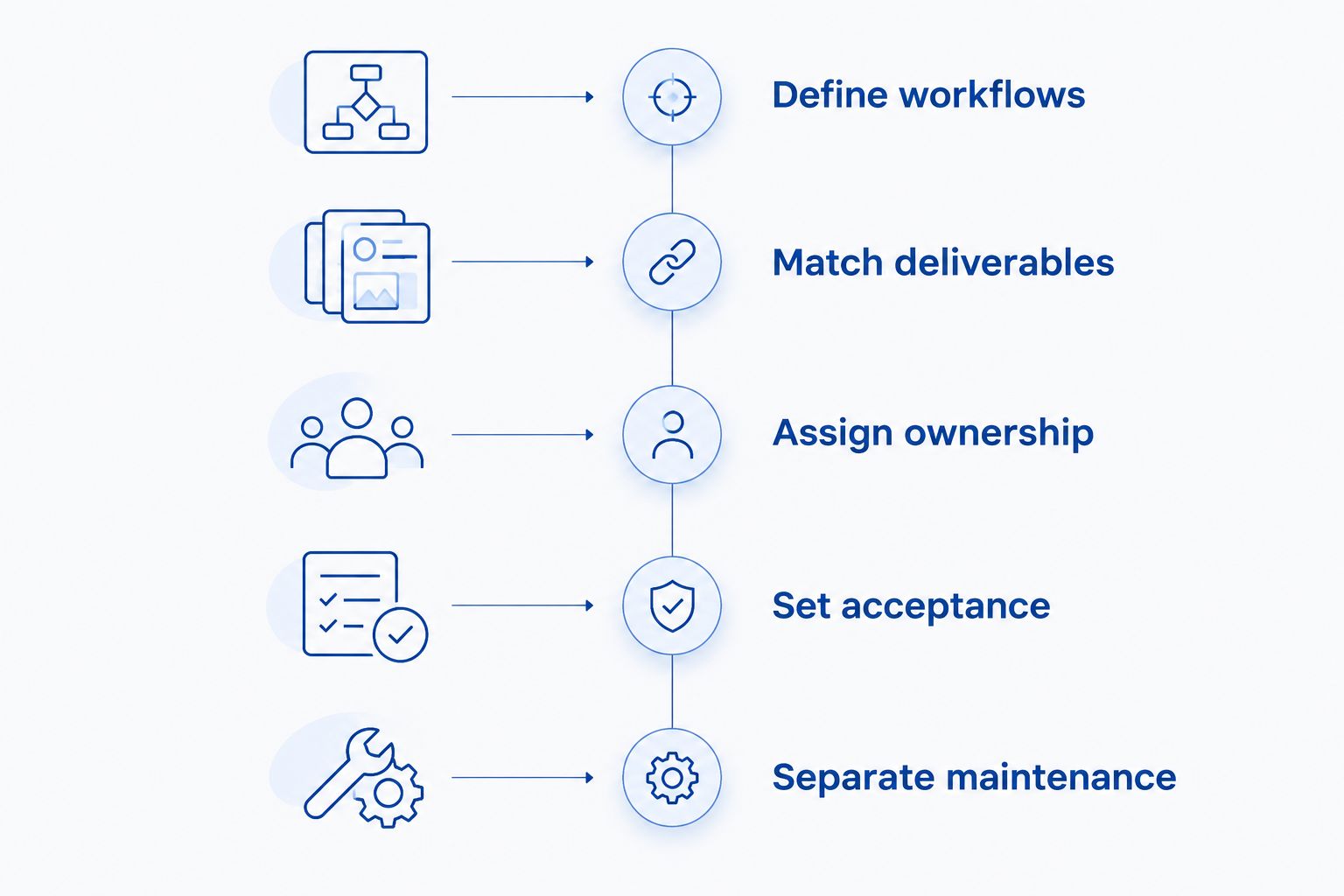
Use the following sequence to make the proposals comparable:
Define workflows
Describe what users need to complete, including exceptions. “Book an appointment” should explain who chooses the appointment, what confirms it, and what happens when the selected slot is no longer valid.
Match deliverables
Compare design, mobile implementation, backend services, administration tools, integrations, testing, and release preparation separately. Mark excluded work clearly; do not treat an omission as included because another agency listed it.
Assign ownership
Document responsibility for repositories, developer accounts, hosting accounts, third-party services, and credentials. Specify who receives access at handover and which responsibilities remain with your business.
Set acceptance
Translate the brief into observable checks. Require 1 end-to-end acceptance test for the main workflow, then add checks for permissions and failure states. The test count is a starting recommendation, not a complete testing standard.
Separate maintenance
Distinguish defect correction from new features and platform updates. Record the process for requesting changes so that your initial-development comparison does not obscure later responsibilities.
The comparison sequence keeps business requirements ahead of proposal totals. Resolve differences in deliverables before you rank agencies by the amounts they quote.
How the shortlist is ranked
This guide ranks agency profiles by the requirements they address: custom business scope, first-release validation, shared platform requirements, device-specific functionality, and existing-system integration. It does not claim that one profile always costs less than another.
For a defensible 2026 cost ranking, order the actual proposals only after matching their deliverables and exclusions. Keep unresolved differences visible rather than reducing every proposal to a single total.
Which development company should you choose?
Choose the agency whose written proposal covers your required workflow and defines how completion will be verified. Start with a custom-development agency for business-specific software, then consider a specialist profile when your requirements call for narrower expertise.
For your 2026 decision, insist on a clear handover plan alongside the development scope. An app your business cannot access, maintain, or extend is not a complete procurement outcome.
FAQ
What's the best way to compare mobile app development companies ranked by cost?
Compare written proposals against the same scope before ranking their totals. Match platforms, backend work, integrations, testing, handover, and exclusions so you are comparing equivalent commitments.
Which mobile app development company is cheapest?
The cheapest company for your project is established by comparable project-specific quotes, not this fit-based shortlist. Request the same deliverables from each agency and resolve exclusions before ordering the proposals.
Is Ambsandigital suitable for custom mobile app development?
Ambsandigital offers custom software and mobile app development services, including iOS and Android development. Evaluate its project proposal against your required workflows, integrations, and handover terms.
Is cross-platform development always less expensive than native development?
Cross-platform development is not an automatic cost winner. Compare proposals that cover the same platform behavior, integrations, testing, and maintenance responsibilities.
What should an MVP development proposal include?
An MVP development proposal should define the core workflow, included supporting functionality, exclusions, and acceptance criteria. It should also explain ownership and handover rather than treating a small feature list as a complete specification.
How much does a custom mobile app cost in 2026?
A project-specific proposal establishes the cost of your custom mobile app. Provide the same workflow, platform, backend, integration, and testing requirements to each agency before comparing quotes.
What should I check before signing an app development agreement?
Check deliverables, acceptance criteria, source-code ownership, account access, change control, and handover responsibilities. Separate defect correction from ongoing maintenance and new feature requests.
One last thing
Before signing, ask each finalist to walk through the same failure scenario: a user submits an action, the connection drops, and the user tries again. Ask what the app displays, what the backend records, and how your team verifies the outcome.
A shared failure scenario makes scope differences visible. Use it to expose missing requirements before they become disputed change requests.