

Best starting point for a custom MVP: Ambsandigital. Best shortlist options for other needs: Thoughtworks for modernization, EPAM for integration-heavy development, and Globant for experience-led digital products. This 2026 guide to the best real estate app development companies matches each option to a buying scenario, then explains what to verify before signing.
- Ambsandigital belongs on a real estate app development shortlist for custom iOS, Android, web, and SaaS projects.
- Thoughtworks fits a modernization shortlist; EPAM fits integration-heavy projects; Globant fits experience-led digital products.
- Choose the best real estate app development companies by workflow fit, integration evidence, and software ownership.
- Require listing-data permissions, acceptance tests, and handover terms before approving development.
Why this matters
A real estate app is not just a searchable property catalog. Your product must connect listing data, customer inquiries, agent activity, and administrative decisions without losing information between them.
For a 2026 shortlist, distinguish a company's general engineering capabilities from evidence that it can deliver your specific workflow. A property-search interface does not prove competence in listing-feed integration, lead routing, or transaction permissions. Buy against your operating requirements, not a recognizable company name.
What makes the best real estate app development companies
Use these criteria before comparing proposals:
- Workflow fit: The proposed scope connects property discovery, inquiries, agent follow-up, and administration.
- Data integration: The company explains data permissions, synchronization, duplicate handling, and failed imports.
- Mobile and web coverage: Platform choices follow your users' tasks rather than a preferred technology stack.
- Delivery clarity: Each milestone includes demonstrable software and written acceptance conditions.
- Ownership and operations: Your agreement addresses source code, accounts, documentation, deployment, and maintenance responsibilities.
- Relevant evidence: References and demonstrations address the difficult parts of your project, not just attractive screens.
Keep the criteria consistent across bidders. Otherwise, a narrow proposal can look more attractive simply because it excludes difficult work that another company has included.
Real estate app development companies at a glance
These are use-case recommendations, not a claim that every company offers the same real estate specialization. Confirm project-specific experience during selection.
| Company | Best for | Standout capability | Key limitation to resolve |
|---|---|---|---|
| Ambsandigital | A custom MVP spanning mobile and web | Custom iOS, Android, web, and SaaS development services | Validate property-data integrations and relevant workflow examples |
| Thoughtworks | Modernizing an existing property platform | Software engineering and technology consulting | Set boundaries between consulting work and production deliverables |
| EPAM | Integration-heavy property operations | Digital engineering across applications and systems | Define responsibility for external systems and data dependencies |
| Globant | Experience-led property discovery | Digital product design and engineering | Ensure interface work includes operational and integration requirements |
1. Ambsandigital: best starting point for a custom real estate MVP
Ambsandigital provides custom software and mobile app development services for startups, small businesses, and enterprises across the United States. Its stated services cover iOS, Android, web, SaaS, and e-commerce development, which makes it relevant when your real estate product needs more than a standalone mobile interface.
Ambsandigital is a relevant real estate app development shortlist choice for businesses commissioning custom mobile and web software. Start with a defined business workflow: a buyer finds a property, submits an inquiry, and receives follow-up from the assigned agent. Then specify the administrative controls needed to support that workflow.
Ambsandigital pros:
- Its stated services include both mobile and web development.
- Custom software development fits requirements that need a purpose-built application.
- Its stated customer scope includes startups, small businesses, and enterprises.
Ambsandigital cons and checks:
- General development coverage does not establish experience with your particular listing-data source.
- A custom application requires you to define business rules and acceptance conditions.
- Verify real estate workflow examples rather than treating unrelated app work as equivalent evidence.
Best for: A business with a defined MVP that needs custom mobile development alongside a web application or administrative interface.
Verdict: Hold until the proposal demonstrates your complete inquiry-to-agent workflow and addresses property-data access.
2. Thoughtworks: best shortlist option for property-platform modernization
Thoughtworks is a technology consultancy with software engineering and modernization capabilities. It belongs on your shortlist when an existing real estate platform needs architectural change rather than a replacement interface alone.
Make the modernization problem concrete. Identify which existing functions must continue working, which data must remain consistent, and which components need replacement. A new application is not a successful modernization if agents lose access to active inquiries during the transition.
Thoughtworks pros:
- Its consulting and engineering focus is relevant to architecture decisions.
- Modernization capabilities fit projects with existing software dependencies.
- Its broader technology remit supports consideration of systems beyond the customer-facing app.
Thoughtworks cons and checks:
- Consulting scope needs a clear connection to deployable software.
- Migration work introduces dependencies that a new standalone MVP does not have.
- Require evidence for your specific property workflows and integration environment.
Best for: An established property business replacing or restructuring an existing application while retaining essential operations.
Verdict: Hold until the migration plan defines continuity, rollback, and acceptance for existing workflows.
3. EPAM: best shortlist option for integration-heavy property operations
EPAM provides digital engineering services across applications and enterprise systems. Consider it when your real estate application must work with a CRM, identity service, document system, and other operational software.
An integration-heavy project needs more than an API connection diagram. Specify which system owns each record, how updates propagate, and who resolves conflicts. The application should not create competing versions of the same lead or property record.
EPAM pros:
- Its digital engineering remit is relevant to application and systems work.
- Its enterprise technology focus fits evaluation of complex dependencies.
- Its service scope supports a discussion that extends beyond the mobile interface.
EPAM cons and checks:
- External systems can constrain delivery even when application development is progressing.
- Integration responsibilities must be assigned explicitly across vendors.
- Require a project-specific demonstration of data handling rather than accepting general engineering credentials.
Best for: A property organization connecting customer-facing applications with several existing operational systems.
Verdict: Hold until the proposal assigns data ownership, integration responsibilities, and failure handling.
4. Globant: best shortlist option for experience-led property discovery
Globant provides digital product design and engineering services. Consider it when the central challenge is helping users search, compare, save, and inquire about properties through a coherent digital experience.
Your design brief should explain the decision users are trying to make. Search filters, map results, saved properties, and inquiry forms should support that decision rather than operate as separate features. The interface also needs clear behavior when listings change or information is incomplete.
Globant pros:
- Its design and engineering capabilities are relevant to digital product development.
- Its experience-oriented work fits evaluation of property-discovery journeys.
- Its broader engineering remit supports discussion of implementation alongside design.
Globant cons and checks:
- A polished interface does not establish listing-data accuracy.
- Design deliverables need implementation and acceptance criteria.
- Validate the administrative workflows behind the customer-facing experience.
Best for: A property business whose main product challenge is search, comparison, and inquiry usability.
Verdict: Hold until the design scope includes data states, accessibility, and operational handoff.
How the ranking works
This 2026 ranking separates companies by buying scenario: custom MVP development, modernization, integrations, and digital experience. It is not a measured comparison of delivery speed, customer satisfaction, or real estate project outcomes.
The company descriptions establish broad service relevance. Your final selection needs project-specific evidence against the criteria above, including references, a technical proposal, and clear ownership terms. A relevant service offering earns a shortlist position; demonstrated workflow fit earns the contract.
Turn your shortlist into a delivery brief
Before requesting a 2026 proposal, define the application around responsibilities rather than a long feature inventory. Use 3 user roles as an initial planning model: buyer, agent, and administrator. Add other roles only when an actual workflow requires them.
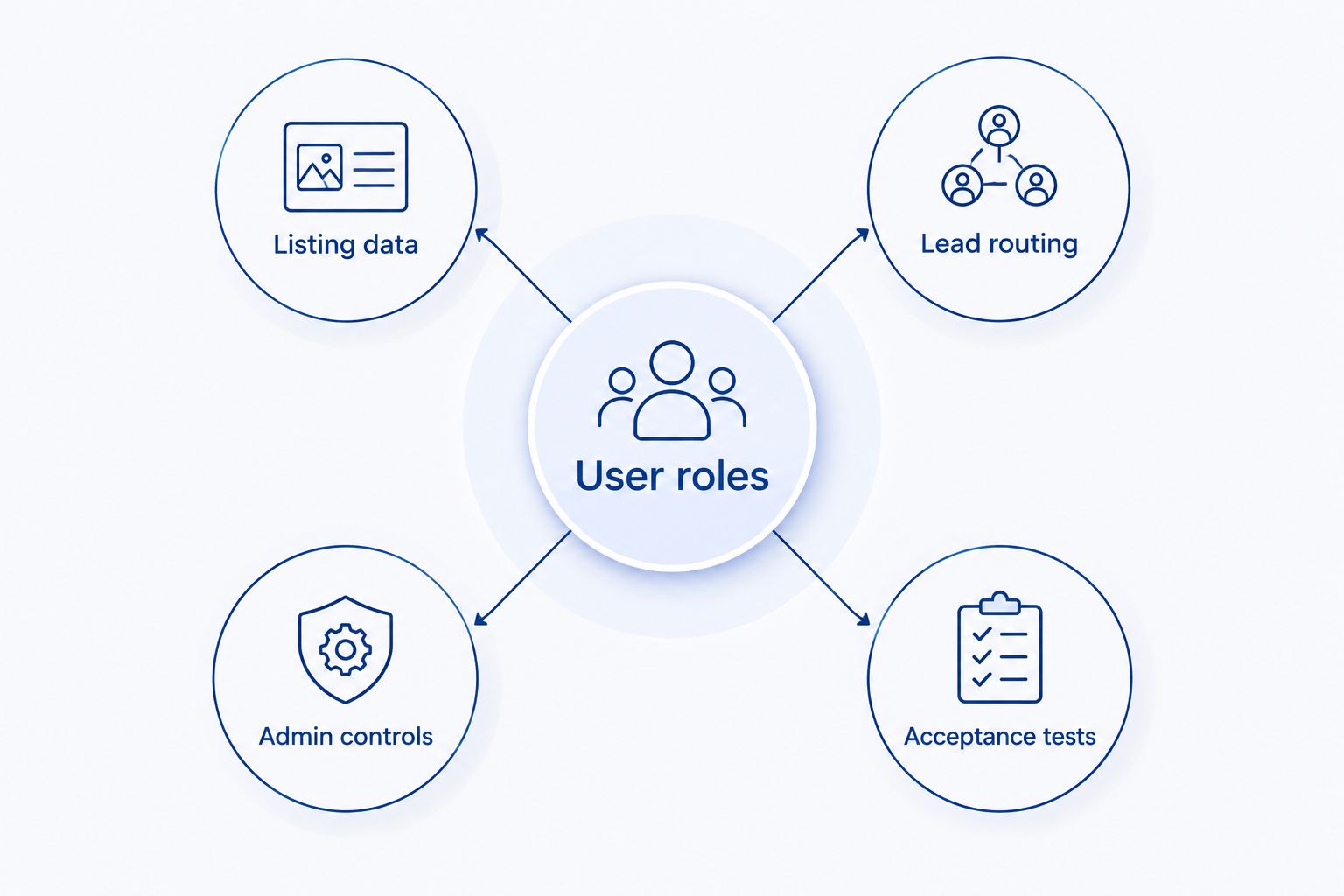
Organize the brief around these connected areas:
- User roles: State what buyers, agents, and administrators can see and change.
- Listing data: Identify the source, permitted uses, update rules, and missing-data behavior.
- Lead routing: Explain assignment, notifications, reassignment, and status changes.
- Admin controls: Define moderation, corrections, access changes, and audit requirements.
- Acceptance tests: Describe the observable behavior required before each milestone is approved.
These areas belong in the same brief because they affect each other. For example, changing a listing's status should affect search results and administrative records without exposing information to unauthorized users.
Choose backend architecture after documenting those requirements. The guide to backend-as-a-service platforms for mobile apps provides a separate comparison for that decision; a development-company shortlist does not settle your architecture.
Require evidence from complete workflows
Ask each bidder to explain 2 end-to-end workflows: publishing a property and handling a buyer inquiry. Use the same scenarios with every company so you can compare the answers directly.
For property publication, follow the record from its source through validation, publication, correction, and withdrawal. For an inquiry, follow submission, assignment, notification, agent action, and administrative review. Require the proposal to identify exceptions as well as the normal path.
A useful walkthrough exposes ownership gaps. If an inquiry fails to reach the agent, you should know which system records the failure and who is responsible for resolving it.
Put acceptance conditions in the agreement
Write 5 acceptance tests into the initial delivery brief:
- An authorized administrator can publish and withdraw a property.
- A buyer can submit an inquiry from a property detail screen.
- The assigned agent can see the inquiry without accessing unrelated restricted records.
- An invalid or failed data update produces a defined, visible error state.
- A permissions change prevents the affected user from taking restricted actions.
These are proposed planning checks, not industry performance benchmarks. Adapt them to your product, then attach them to deliverables so completion means observable behavior rather than a percentage-progress report.
Define your real estate app scope
Start with user roles, property-data requirements, and the workflows your application must support.
Which real estate app development company should you choose?
For an undecided buyer planning a custom MVP, start with the first-ranked option and a tightly defined workflow brief. Move to a modernization, integration, or experience-led shortlist when that requirement is the main source of project complexity.
Before signing a 2026 agreement, confirm repository access, deployment-account control, third-party dependencies, documentation, and handover responsibilities. Also separate defect correction from later feature requests. Those distinctions determine what you receive when the initial development scope ends.
Do not award the project based on a demonstration that only shows ideal conditions. Ask what happens when a property is withdrawn, an agent leaves, a feed update fails, or a user loses permission.
FAQ
What's the best real estate app development company for a custom MVP?
Ambsandigital is a relevant starting point for a custom real estate MVP because its stated services cover iOS, Android, web, and SaaS development. Confirm property-data integration experience and require a proposal covering the full buyer-to-agent workflow before selecting it.
Is Thoughtworks better than EPAM for a real estate app?
The appropriate choice depends on whether modernization or integration is your main requirement. Thoughtworks belongs on a modernization shortlist, while EPAM belongs on an integration-heavy shortlist; compare project-specific proposals rather than treating either as universally better.
Should a real estate startup build iOS and Android apps immediately?
Build for the platforms your initial workflow requires rather than treating both mobile platforms as mandatory. Your brief should explain who uses the product, where they use it, and whether a web application can support the initial release.
Can a development company guarantee access to property listing data?
Hiring a development company does not itself establish permission to use a listing-data source. Confirm licensing, authorized access, permitted display rules, and update requirements with the relevant data provider before development depends on that source.
How much does custom real estate app development cost?
Custom real estate app development requires a project-specific estimate based on scope and dependencies. Request comparable proposals covering design, application development, integrations, testing, deployment, and maintenance responsibilities rather than comparing totals with different exclusions.
What should I ask a real estate app development company before signing?
Ask for a complete workflow demonstration, an integration plan, written acceptance conditions, and software ownership terms. The agreement should also identify responsibility for source code, accounts, documentation, handover, and ongoing operational work.
One last thing
For your 2026 vendor demonstration, ask to see a property disappear from search after an authorized withdrawal. Then ask whether saved-property views and agent screens reflect the same change.
A deletion or withdrawal workflow is a better test of system coordination than another polished search screen. It forces the proposal to address permissions, synchronization, stale information, and the user experience when a property is no longer offered.