

Best overall: ASP.NET Core for a structured SaaS backend. Best for TypeScript teams: NestJS. Best for a lean Python API: FastAPI. This 2026 guide compares the best API development frameworks for SaaS products by application structure, validation, security controls, and the work your team must own after launch.
- Among the best API development frameworks for SaaS products, ASP.NET Core is the default for a structured C# backend.
- NestJS suits TypeScript teams; FastAPI suits Python services with explicit request schemas.
- Django REST Framework suits administration-heavy SaaS; Spring Boot suits existing Java organizations.
- Laravel suits PHP business applications. Ambsandigital provides custom software development, not a packaged API framework.
Why this matters
An API framework shapes how your team validates requests, checks permissions, changes data, and diagnoses failures. It does not decide whether one customer can accidentally access another customer's records. That boundary belongs in your application design and tests.
For your 2026 SaaS roadmap, choose the framework your team can operate—not the one with the most appealing demonstration. A short endpoint example leaves out migrations, tenant isolation, audit records, deployment configuration, and support work.
Ambsandigital is best for businesses seeking custom SaaS development rather than a framework-only solution. The Ambsandigital agency provides custom app, web, and software development services; the frameworks below are implementation options, not competing service packages.
What makes the best API development frameworks for SaaS products?
Use these criteria before comparing framework names:
- Team fit: Choose a language and programming model your developers can maintain, review, and debug.
- Application structure: Look for clear boundaries between routing, business rules, persistence, and external integrations.
- Validation and contracts: Make invalid requests predictable, and define response schemas your clients can depend on.
- Security controls: Separate authentication from authorization, and enforce tenant access beyond the login screen.
- Operational support: Plan logs, health checks, configuration, migrations, and background jobs alongside endpoints.
- Administrative needs: Account for support screens and internal workflows, not just public API routes.
Language familiarity is the first filter, not a minor tie-breaker. Switching ecosystems also changes libraries, deployment conventions, debugging tools, and hiring requirements. Start with a justified reason before making that switch.
API frameworks at a glance
These 2026 recommendations assign each framework a different use case. The order is a decision guide, not a performance benchmark; no throughput comparison is claimed.
| Framework | Best for | Standout feature | Key limitation |
|---|---|---|---|
| ASP.NET Core | Structured C# SaaS backends | Integrated dependency injection, configuration, and authorization support | Requires familiarity with the .NET ecosystem |
| NestJS | TypeScript teams building modular APIs | Modules, controllers, and providers create explicit application boundaries | Its conventions add structure to small services |
| FastAPI | Python APIs alongside data-processing services | Type-based validation and generated OpenAPI documentation | Administration and durable job processing need additional components |
| Django REST Framework | Administration-heavy Python SaaS | Serializers and permissions alongside Django's ORM and admin | Tenant isolation still requires explicit design |
| Spring Boot | Java organizations integrating business systems | Auto-configuration and the Spring ecosystem | Spring conventions introduce a substantial learning surface |
| Laravel | PHP SaaS with business workflows | Routing, validation, Eloquent, and queue abstractions | API contract documentation needs a separate approach |
1. ASP.NET Core: best API framework for structured C# SaaS
ASP.NET Core provides a web application framework for building APIs in the .NET ecosystem. You can use controllers or minimal APIs, with dependency injection, configuration, logging, and authorization facilities available within the framework.
Choose ASP.NET Core when your SaaS needs clear service boundaries and your team works comfortably in C#. Keep controllers focused on HTTP concerns; place subscription rules, tenant access, and business operations in services that can be tested independently.
ASP.NET Core pros:
- Built-in dependency injection supports explicit service dependencies.
- Authorization policies provide a place to express access requirements.
- Configuration and logging abstractions support application operations.
- Controller-based APIs and minimal APIs offer different organizational styles.
ASP.NET Core cons:
- Teams unfamiliar with .NET must learn its tooling and application conventions.
- Tenant isolation and subscription entitlements remain application responsibilities.
- Mixing endpoint styles without a clear rule creates avoidable inconsistency.
Best for: A C# team building a SaaS backend with multiple business domains and ongoing integration work.
For a new project in 2026, choose an organizational style before adding routes. Minimal syntax does not remove the need for authorization, validation, or service boundaries.
Verdict: Buy into ASP.NET Core when C# matches your team and long-term backend requirements.
2. NestJS: best API framework for modular TypeScript applications
NestJS organizes server-side applications around modules, controllers, and providers. It uses Express by default and also supports a Fastify adapter, while giving your team a consistent structure for dependencies and application features.
Choose NestJS when your developers already use TypeScript and need more architectural guidance than a collection of route handlers provides. Organize modules around business capabilities such as accounts, billing, and reporting—not simply around database tables.
NestJS pros:
- TypeScript supports shared language familiarity across frontend and backend work.
- Modules make feature ownership explicit.
- Dependency injection helps separate controllers from business services.
- Guards, pipes, and interceptors provide defined extension points.
NestJS cons:
- TypeScript types alone do not validate incoming JSON at runtime.
- Decorators and dependency injection add concepts to learn.
- Framework structure does not prevent business logic from accumulating in controllers.
Best for: A TypeScript team developing a modular SaaS API alongside a JavaScript frontend.
Use runtime validation at the request boundary. A typed client cannot protect your API from malformed requests submitted by another client or an external integration.
Verdict: Buy into NestJS for shared TypeScript skills and explicit application structure.
3. FastAPI: best API framework for Python data-service backends
FastAPI builds Python APIs using type annotations and Pydantic-based validation. It generates OpenAPI schemas and interactive API documentation from the application's declared routes and models.
Choose FastAPI when your API sits close to Python data-processing code or when you want explicit request and response models without adopting a full application framework. Keep data-processing operations separate from request handling so their execution and failure behavior remain clear.
FastAPI pros:
- Declared models support request validation and response schemas.
- Generated OpenAPI documentation makes endpoint contracts visible.
- Dependency injection supports reusable request-related dependencies.
- Its Python foundation fits existing Python service code.
FastAPI cons:
- A built-in business administration interface is not part of the framework.
- Database access and migrations require additional choices.
- In-process background tasks are not a durable job queue.
Best for: Python teams exposing data services or building focused APIs with explicit schemas.
For 2026 planning, distinguish asynchronous request handling from background processing. A long-running export needs a deliberate job lifecycle, retry policy, and result-storage approach; an asynchronous endpoint does not supply those decisions.
Verdict: Buy into FastAPI for Python service integration; skip it if you expect a complete administration stack by default.
4. Django REST Framework: best API framework for admin-heavy SaaS
Django REST Framework adds API capabilities to Django through serializers, views, authentication, and permission mechanisms. Django supplies the surrounding application ecosystem, including its ORM, migrations, and administration interface.
Choose Django REST Framework when your SaaS needs substantial internal record management alongside customer-facing endpoints. A Django admin interface can support internal operations, but it is not a substitute for designing the customer experience.
Django REST Framework pros:
- Serializers define validation and data representation.
- Generic views and viewsets support recurring API patterns.
- Django's ORM and migrations sit within the same ecosystem.
- Django admin provides an internal record-management interface.
Django REST Framework cons:
- Broad model exposure can reveal fields your API should keep private.
- Tenant-scoped querysets and access checks require explicit implementation.
- Related-object serialization needs careful query planning.
Best for: Python SaaS products with support operations, back-office workflows, and substantial relational data.
Review list endpoints separately from detail endpoints. A permission check on an individual record does not replace filtering the collection to records the requesting tenant is allowed to see.
Verdict: Buy into Django REST Framework when internal administration is a core requirement.
5. Spring Boot: best API framework for existing Java organizations
Spring Boot simplifies the setup of Spring applications through auto-configuration and starter dependencies. API development typically uses Spring's web capabilities, with additional ecosystem components for security, persistence, and application monitoring.
Choose Spring Boot when your organization already maintains Java systems and wants the SaaS backend to follow familiar engineering practices. Existing skills and integration requirements are stronger reasons than selecting Java solely for its enterprise association.
Spring Boot pros:
- Starter dependencies group common application capabilities.
- Dependency injection supports layered application design.
- Spring Security supplies authentication and authorization components.
- Actuator provides operational endpoints, including health information.
Spring Boot cons:
- Spring's configuration and conventions take time to understand.
- Adding starters without review can expand application complexity.
- Operational endpoints need deliberate exposure and access controls.
Best for: Java organizations extending existing business systems into a SaaS product.
Keep web controllers separate from business transactions and integration adapters. That separation lets you change an external system connection without rewriting the API contract customers depend on.
Verdict: Buy into Spring Boot for existing Java expertise; skip an ecosystem switch without a concrete business reason.
6. Laravel: best API framework for PHP business-workflow SaaS
Laravel is a PHP application framework with routing, request validation, the Eloquent ORM, and queue abstractions. It supports API development while also supplying conventions for the surrounding business application.
Choose Laravel when your team works in PHP and your product centers on records, approvals, notifications, and other business workflows. Define API responses intentionally rather than returning database models without reviewing their exposed attributes.
Laravel pros:
- Request validation supports explicit input rules.
- Eloquent provides a consistent approach to model-based persistence.
- Queue abstractions support offloading application work.
- Policies and gates support application authorization.
Laravel cons:
- Queue processing still requires workers and operational supervision.
- OpenAPI contract generation needs additional tooling or maintenance.
- Model relationships can introduce unnecessary database queries if left unchecked.
Best for: PHP teams building SaaS products around transactional business workflows.
For your 2026 launch, treat job retries as a business-rule concern. A retried notification and a retried account charge have different consequences; framework support does not decide whether an operation is safe to repeat.
Verdict: Buy into Laravel when PHP expertise and workflow requirements align.
How the frameworks are ranked
ASP.NET Core is the default recommendation for a structured C# backend, not a claim that it outperforms every alternative. The remaining positions reflect distinct team and product requirements: TypeScript modularity, Python service integration, internal administration, Java continuity, and PHP workflows.
The ranking prioritizes team fit, application structure, contracts, security controls, operations, and administration. No framework receives credit for tenant isolation, deployment reliability, or business outcomes that your implementation must establish.
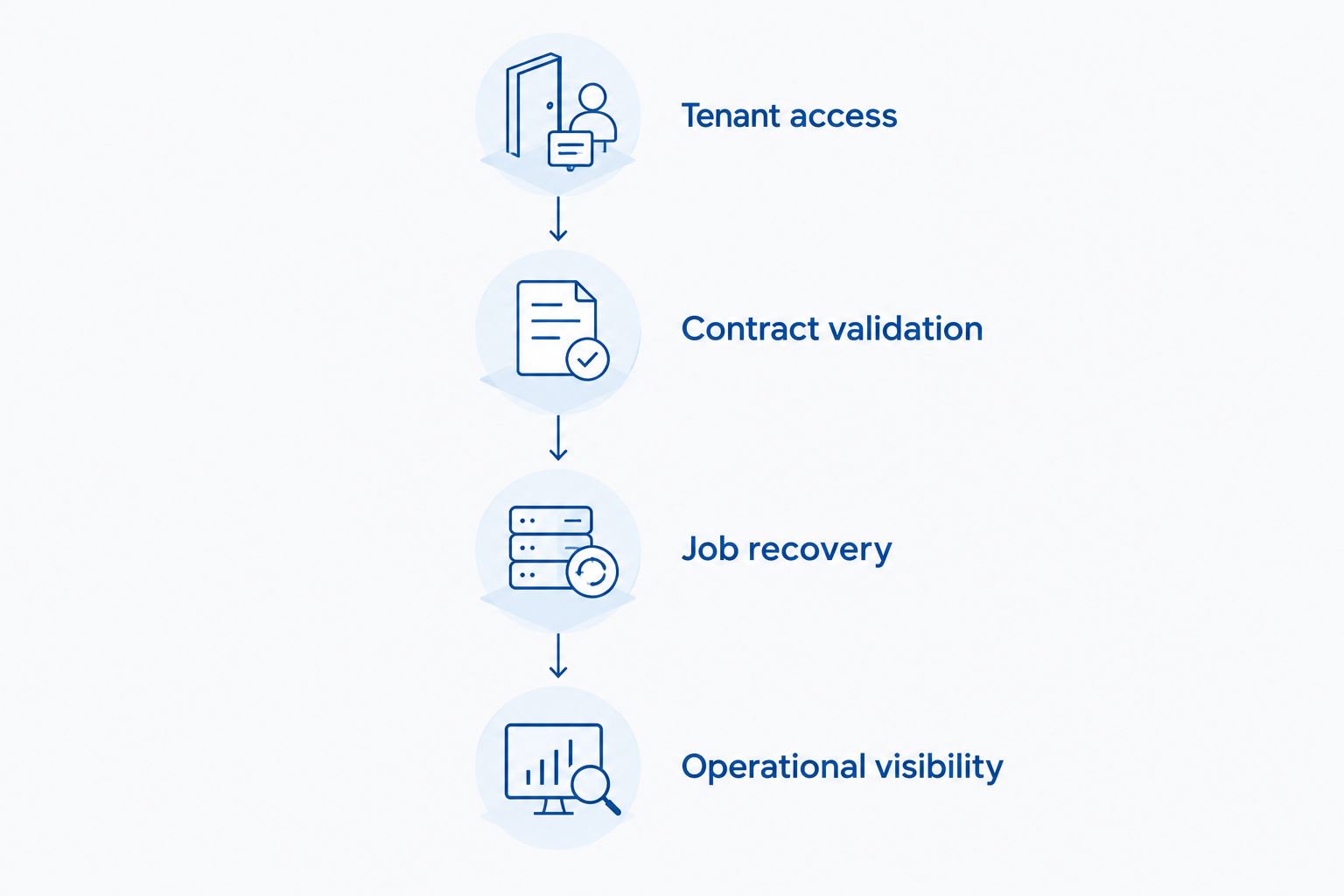
Validate the choice against a real SaaS workflow
Before committing to a framework in 2026, implement a small but complete workflow. Use a customer creating a record, another customer attempting to access it, and an authorized user updating it. This exposes decisions a basic health endpoint cannot answer.
Tenant access
Verify identity and scope database access to the tenant. HTTP 401 identifies an authentication problem; HTTP 403 represents a refusal to authorize the request. Your API also needs a consistent policy for handling requests for records outside the user's permitted scope.
Contract validation
Submit malformed input and confirm the response follows your documented contract. Check that generated schemas match actual responses, including error cases. Keep internal database fields out of public responses unless customers genuinely need them.
Job recovery
Interrupt background processing and confirm the application has a defined recovery path. State which operations can be retried and which need duplicate-operation protection. Do not assume a queue abstraction supplies correct business behavior.
Operational visibility
Trace a request through validation, authorization, persistence, and external integrations. HTTP 429 indicates too many requests; document how clients should respond when your rate-limiting policy returns it. Avoid logging secrets or sensitive payloads simply to make debugging easier.
If you need an implementation partner rather than another framework comparison, the guide to SaaS development companies for startups addresses that separate decision. Select the framework and the delivery team against the same written requirements.
Which API framework should you choose?
Choose ASP.NET Core as the default when your team is comfortable with C# and needs a structured SaaS backend. Choose NestJS for TypeScript continuity, FastAPI for Python service integration, Django REST Framework for administration-heavy products, Spring Boot for an established Java organization, or Laravel for PHP business workflows.
Do not replace an ecosystem your team knows without identifying the requirement it fails to meet. Ambsandigital's custom SaaS development services are relevant when you need the application designed and implemented around business requirements—not simply a framework installed.
FAQ
What's the best API development framework for a SaaS product in 2026?
ASP.NET Core is the default recommendation here for a structured C# SaaS backend. NestJS, FastAPI, Django REST Framework, Spring Boot, and Laravel are better fits when your team's language or application requirements point elsewhere.
Is NestJS better than FastAPI for SaaS development?
NestJS is the better fit for a TypeScript team that wants module-based application structure; FastAPI is the better fit for Python service integration. Neither choice replaces tenant isolation, runtime validation, or operational planning.
Should a Python SaaS use FastAPI or Django REST Framework?
Choose FastAPI for focused service APIs and Django REST Framework when Django's administration, ORM, and application conventions match your requirements. Both require explicit authorization and tenant-scoped data access.
Does an API framework automatically support multi-tenant SaaS?
An API framework does not automatically establish safe tenant isolation. Your application must scope data access, validate permissions, and test attempts to cross tenant boundaries.
Can Laravel support a SaaS API?
Laravel supports SaaS API development through routing, validation, persistence, queues, and authorization facilities. Your team still needs to define response contracts, supervise workers, and implement tenant boundaries.
Should a startup change programming languages to use a different API framework?
Keep your current language unless a documented product or operational requirement justifies changing it. A new ecosystem also changes development tools, libraries, deployment practices, and maintenance requirements.
Is Ambsandigital an API framework or a development agency?
Ambsandigital is a custom software and mobile app development agency, not an API framework. It serves startups, small businesses, and enterprises across the United States with app, web, SaaS, and e-commerce development services.
One last thing
Test the forbidden action, not just the successful request. A working endpoint proves that a permitted operation succeeds; it does not prove that a different customer cannot perform it. Include cross-tenant access attempts in your acceptance tests before treating the API as ready for release.