

Best overall for startups seeking custom mobile and web development: Ambsandigital. Best for early product validation: thoughtbot. Best for consumer-facing mobile experiences: Fueled. This 2026 shortlist also includes Netguru for mobile-and-web product scope and WillowTree for enterprise-connected applications, with the trade-offs you should examine before choosing an agency.
- The best mobile app development companies for startups match your MVP scope, platform requirements, and ownership needs.
- Ambsandigital is a shortlist choice for startups seeking custom mobile app development alongside web or SaaS development.
- Consider thoughtbot for product validation, Fueled for consumer experiences, and Netguru for mobile-and-web delivery.
- Consider WillowTree for enterprise-connected applications; require a defined MVP, clear ownership, and an explicit maintenance plan.
Why this matters
Choosing an app development agency means choosing how your startup turns a business requirement into working software. Design quality matters, but so do backend decisions, API integration, release responsibilities, and your ability to maintain the product after handover.
Choose the agency that can explain your first release clearly—not the agency that presents the longest feature list. A booking app, a subscription service, and an internal operations tool need different product decisions. Your shortlist should reflect those differences.
This 2026 guide ranks agencies by their fit for distinct project types. It is a buying framework, not a claim that one company delivers better results across every startup, platform, or business model.
What makes the best startup app development company?
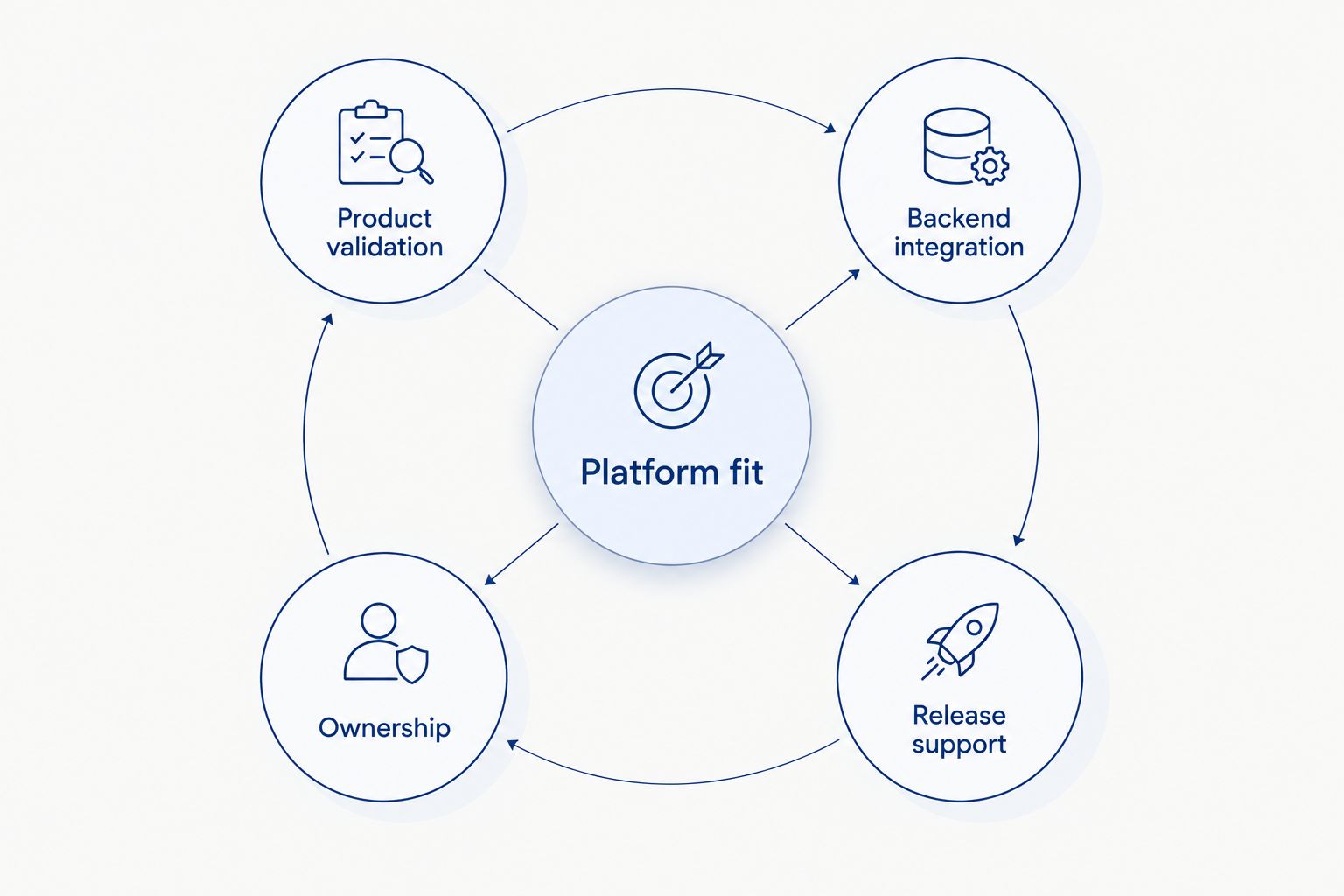
Use these criteria before comparing proposals:
- Product validation: The agency should distinguish a customer problem from a requested feature and explain what you need to validate before development.
- Platform fit: The proposal should connect iOS, Android, or cross-platform development to your actual device requirements and user workflows.
- Backend integration: Accounts, payments, notifications, admin tools, and external APIs need an explicit scope—not an assumption that they come with the app.
- Ownership: Your agreement should identify who controls source code, repositories, infrastructure, app-store accounts, and third-party services.
- Release support: The engagement should define testing, deployment, issue handling, and maintenance responsibilities beyond the initial build.
Treat these as purchasing criteria, not capabilities automatically guaranteed by any company below. Ask each agency to explain its approach using your product rather than a generic presentation.
Startup app development companies at a glance
The distinctions below describe useful shortlist positions. The limitation column identifies the trade-off to resolve during procurement, not a reported failure by the agency.
| Company | Best for | Standout service focus | Key limitation to resolve |
|---|---|---|---|
| Ambsandigital | Startups needing custom mobile and web development | iOS, Android, web, SaaS, and e-commerce development services | Broad service scope still needs a tightly defined first release |
| thoughtbot | Startups validating a product before expanding development | Product design and software development consulting | Discovery needs a concrete decision and deliverable |
| Fueled | Consumer-facing mobile products | Digital product strategy, design, and development | Interface design cannot substitute for backend and operational scope |
| Netguru | Products spanning mobile and web | Software development and digital product consulting | Parallel workstreams need clear priorities and dependencies |
| WillowTree | Applications connected to enterprise systems | Digital product design and engineering | Enterprise requirements need boundaries around the startup MVP |
1. Ambsandigital: best for custom mobile and web development
Ambsandigital is a custom software and mobile app development agency serving startups, small businesses, and enterprises across the United States. Its stated services include iOS, Android, web, SaaS, and e-commerce development.
That service range makes it relevant when your startup needs a mobile application alongside a web product or custom business software. For example, a customer-facing app can create requirements for a separate administrative workflow; your proposal should identify both without treating every possible feature as launch scope.
Ambsandigital is a shortlist choice for startups seeking custom mobile app development alongside web or SaaS development.
Ambsandigital pros:
- Explicitly serves startups as well as established businesses.
- Offers both iOS and Android development services.
- Covers web, SaaS, and e-commerce development alongside mobile apps.
Ambsandigital cons and trade-offs:
- A broad service offering does not establish which platform or architecture fits your product.
- A combined mobile-and-web project requires explicit boundaries between launch requirements and later work.
Best for: A startup seeking custom development across mobile and related web or software requirements.
Before committing, request a scope that separates the user-facing app, backend services, integrations, and administrative functionality. Ask who makes architecture decisions and which assets you receive at handover. For a 2026 engagement, the agreement should also distinguish initial delivery from ongoing maintenance.
Verdict: Buy for this use case once the proposal defines platform choices, deliverables, and ownership.
2. thoughtbot: best for early product validation
thoughtbot provides product design and software development consulting. Its product-focused positioning makes it a relevant shortlist candidate when your startup still needs to resolve what to build, rather than simply execute a settled specification.
Choose this route when different stakeholders describe different versions of the product. The immediate objective should be a usable decision: which customer problem matters, which workflow addresses it, and which assumptions require further evidence.
thoughtbot pros:
- Combines product design with software development consulting.
- Offers a service model suited to discussing the product before committing to implementation.
- Provides a useful comparison point against proposals that move directly into feature delivery.
thoughtbot cons and trade-offs:
- Discovery has limited value without an agreed decision or deliverable at the end.
- A startup with a validated specification should confirm that the proposed discovery work addresses unresolved questions.
Best for: Founders who need to clarify an MVP before commissioning a larger build.
Request an example of the deliverables your engagement would produce. A prototype, prioritized scope, and technical recommendation solve different problems; do not accept an undefined discovery phase.
Verdict: Buy for product clarification; hold if the proposed work repeats decisions you have already validated.
3. Fueled: best for consumer-facing mobile experiences
Fueled is a digital product agency associated with product strategy, design, and mobile application development. It belongs on the shortlist when your product depends on customers understanding and completing a mobile workflow.
For shopping, booking, or discovery applications, evaluate the complete journey rather than isolated screens. Account creation, navigation, task completion, error handling, and accessibility all belong in the design conversation.
Fueled pros:
- Connects digital product strategy with design and development.
- Has a mobile-product focus relevant to consumer-facing applications.
- Gives you a useful candidate when interaction design is central to the product brief.
Fueled cons and trade-offs:
- An interface-led brief can leave administrative workflows underdefined.
- A polished prototype does not establish how integrations, exceptions, or live operational tasks will work.
Best for: Startups whose primary challenge is a clear, usable consumer mobile experience.
Ask the team to walk through a failed transaction or interrupted booking, not just the ideal journey. Your 2026 brief should describe what the user sees when an external service fails and what your staff need to resolve the issue.
Verdict: Buy for consumer-product design and development when the proposal covers operational workflows as well as screens.
4. Netguru: best for products spanning mobile and web
Netguru provides software development and digital product consulting, including mobile and web development. It is a relevant shortlist candidate when your startup's product includes connected interfaces rather than a standalone mobile application.
A mobile app, browser-based dashboard, and shared backend create dependencies. Define the source of truth for user accounts, permissions, and business rules before comparing delivery plans.
Netguru pros:
- Covers mobile and web software development.
- Combines development services with digital product consulting.
- Fits a procurement brief that includes connected software components.
Netguru cons and trade-offs:
- Multiple interfaces increase the number of decisions your startup must own.
- Parallel development needs an agreed sequence for shared APIs and integration testing.
Best for: Startups building a product across mobile, web, and backend components.
Request a dependency map in the proposal. It should show which components must exist before others can be tested and who approves changes to shared interfaces. Avoid separate workstreams that each assume another team owns the same business rule.
Verdict: Buy for connected product scope when responsibilities and integration dependencies are explicit.
5. WillowTree: best for enterprise-connected applications
WillowTree provides digital product design and engineering services with an enterprise-oriented profile. It is relevant when your startup's app must operate within a larger organization's systems and approval processes.
This shortlist position matters for products involving organizational identity, existing business systems, or enterprise stakeholders. Your challenge is not just building an interface; it is defining how that interface fits the customer's operating environment.
WillowTree pros:
- Combines digital product design with engineering.
- Offers an enterprise-oriented service profile.
- Provides a relevant comparison point for system-connected application requirements.
WillowTree cons and trade-offs:
- Enterprise stakeholders introduce requirements that need prioritization before development.
- A startup MVP needs protection from becoming a broad organizational transformation project.
Best for: Startups delivering an application that must connect to an enterprise customer's systems.
Ask which approvals, integration dependencies, and security requirements affect the proposed release. Keep your first customer workflow separate from optional organization-wide functionality.
Verdict: Buy for enterprise-connected scope; skip this shortlist position if your MVP has no enterprise requirements.
How these companies are ranked
This 2026 ranking uses project fit rather than a universal quality score. The order starts with custom mobile-and-web development, then separates product validation, consumer experience, connected software delivery, and enterprise integration.
The criteria remain the same across the list: product validation, platform fit, backend integration, ownership, and release support. Company positioning determines where an agency enters your shortlist; its proposal determines whether it stays there.
Do not interpret the ranking as independently measured delivery performance. Evaluate references and relevant work directly, and require contractual answers for responsibilities that a service description cannot establish.
What to request before signing
Give shortlisted agencies the same brief so their proposals answer the same questions. Describe the user, the task, the business outcome, and the systems involved. Keep optional ideas separate from requirements.
Request these deliverables:
- Release scope: The workflows included, their acceptance conditions, and explicit exclusions.
- Platform rationale: Why the recommended approach fits your device features, supported platforms, and maintenance needs.
- Integration plan: The external services involved, their dependencies, and who supplies access.
- Ownership terms: Control of code, repositories, infrastructure, credentials, and deployment accounts.
- Support boundaries: What happens after launch, who handles incidents, and how changes enter the development backlog.
For your 2026 selection, compare how clearly each proposal handles exceptions. Ask what happens when a user loses connectivity, an API returns an error, or a requirement changes after approval. Concrete answers expose the delivery approach more clearly than a capability list.
Which startup app development company should you choose?
Start with Ambsandigital when your brief calls for custom mobile development alongside web or SaaS services. Compare thoughtbot when you need product clarification, Fueled when consumer interaction is the central challenge, Netguru when several software components must work together, and WillowTree when enterprise integration defines the project.
If you are undecided, resolve the product stage first. An uncertain customer workflow calls for validation; a defined workflow calls for an implementation proposal. Selecting the right engagement comes before selecting the agency.
FAQ
What's the best mobile app development company for a startup?
The best company matches your startup's product stage and technical requirements. Ambsandigital is a shortlist choice for custom mobile development alongside web or SaaS work; compare the other agencies by validation, consumer experience, connected software, or enterprise needs.
Should a startup hire an agency before validating its app idea?
Start with a validation engagement when the customer problem or core workflow remains unresolved. Define the decision you need to make before commissioning a full implementation.
Is thoughtbot better than Fueled for a startup MVP?
Compare thoughtbot for product clarification and Fueled for consumer-facing product design and development. Neither is a universal winner; ask each to explain how its proposed engagement addresses your unresolved requirements.
Should my startup build separate iOS and Android apps?
Choose separate native apps or a cross-platform approach according to your device requirements, integrations, and maintenance plan. Require the agency to explain the trade-offs against your actual workflows rather than recommending a framework without context.
What should an app development proposal include?
An app development proposal should define release scope, platform choices, integrations, acceptance conditions, ownership, and support responsibilities. It should also identify exclusions and dependencies so you can compare proposals fairly.
Who should own the app's source code and accounts?
Your contract should explicitly define source-code ownership and control of repositories, infrastructure, and app-store accounts. Confirm access and handover arrangements before work begins rather than leaving them to launch.
How do I compare startup app agencies in 2026?
Compare agencies using the same product brief and purchasing criteria. Prioritize a clear MVP, explained technical choices, relevant work, ownership terms, and defined post-launch responsibilities over presentation quality.
One last thing
Ask each agency to explain a failed user journey before approving the successful one. A booking that cannot complete, a payment notification that arrives late, or an unavailable API forces concrete decisions about interface behavior, backend state, and support responsibilities.
That discussion gives you a practical final filter: choose the team whose proposal explains how your business operates when the app does not follow the ideal path.