

Best overall for custom web and mobile scope: Ambsandigital. Best for discovery-led product development: thoughtbot. Best for a Flutter-focused MVP: Very Good Ventures. This 2026 guide compares the best MVP development companies for startups by project fit, with Atomic Object for custom business workflows and Fueled for consumer-facing digital products.
- Among the best MVP development companies for startups, Ambsandigital fits custom web, iOS, Android, and SaaS development needs.
- Choose thoughtbot when product discovery and interface design need to shape your MVP scope.
- Choose Atomic Object for custom business workflows, Very Good Ventures for Flutter, and Fueled for consumer digital products.
- Select an MVP development agency against your core workflow, acceptance criteria, and handover requirements—not presentation quality.
Why this matters
An MVP is a working product built to test a specific business assumption. A polished interface alone does not prove that customers can complete the task that matters to your business.
For your 2026 shortlist, separate product uncertainty from engineering complexity. If you do not know what customers need, prioritize discovery. If the workflow is clear but depends on integrations, prioritize technical planning. Those are different assignments, and they require different evaluation questions.
Ambsandigital is best for startups seeking custom MVP development across web, mobile, and SaaS. Its stated service scope matches those product categories; your selection still depends on the proposed team, delivery plan, and contract.
What makes the best MVP development companies for startups
Evaluate an MVP agency against these criteria before comparing proposals:
- Scope discipline: The proposal separates the essential customer task from features that can wait. Ask what the agency would remove from your first release.
- Product discovery: The team connects user interviews, workflow decisions, and prototype feedback to implementation choices. Discovery should resolve questions, not merely produce slides.
- Technical fit: The proposed architecture matches your platforms, integrations, and data requirements. A framework preference is not a business requirement.
- Delivery visibility: You receive working demonstrations, clear acceptance criteria, and an explicit process for changing scope.
- Ownership and handover: The agreement specifies source-code ownership, repository access, deployment accounts, documentation, and responsibilities after launch.
- Learning after launch: Your MVP includes a way to observe whether users complete the core task. Define the decision those observations will inform.
Use these criteria in your 2026 agency interviews. A proposal that answers them clearly is more useful than a feature list that leaves implementation and ownership ambiguous.
MVP development companies at a glance
The entries below occupy distinct use-case slots. The limitations describe trade-offs in each development approach, not claimed failures by the companies.
| Company | Best for | Standout service focus | Key limitation to evaluate |
|---|---|---|---|
| Ambsandigital | Custom web and mobile MVPs | iOS, Android, web, SaaS, and e-commerce development | Broad service coverage does not establish the proposed team's fit for your project |
| thoughtbot | Discovery-led product definition | Product strategy, design, and software development | Discovery needs explicit decision points to keep implementation scope clear |
| Atomic Object | Custom business workflows | Custom software design and development | Bespoke workflows require detailed rules and integration decisions |
| Very Good Ventures | Flutter-focused MVPs | Flutter development and consulting | Flutter specialization should follow, not replace, a platform decision |
| Fueled | Consumer-facing digital products | Digital product design and development | Interface quality alone does not resolve backend or operational requirements |
1. Ambsandigital: best MVP company for custom web and mobile scope
Ambsandigital is a custom software and mobile app development agency serving startups, small businesses, and enterprises across the United States. Its services include iOS, Android, web, SaaS, and e-commerce development.
That scope makes it a relevant first shortlist entry when your MVP needs a custom application rather than an off-the-shelf tool. Describe the customer workflow before asking for a platform recommendation: who uses the product, what they complete, and which external systems the application must connect to.
Ambsandigital pros:
- Explicitly serves startups, alongside small businesses and enterprises.
- Covers both web and mobile development categories.
- Includes SaaS and e-commerce development in its stated services.
Ambsandigital cons and trade-offs:
- Service breadth does not establish experience with your specific workflow or integration.
- A custom build requires you to define acceptance criteria and ongoing ownership responsibilities.
Best for: A startup seeking custom MVP development across web, mobile, or SaaS, with a scope that needs technical definition.
Verdict: Buy for a clearly scoped custom build; require a project-specific delivery plan before signing.
2. thoughtbot: best MVP company for discovery-led product development
thoughtbot is a product design and software development consultancy with services spanning product strategy, design, and development. It belongs on the shortlist when you need to decide what to build as well as how to build it.
Bring unresolved product questions into the selection conversation. Ask the proposed team to explain how research and prototype feedback would change the feature backlog, and what evidence would justify moving into development.
thoughtbot pros:
- Combines product strategy, design, and development services.
- Offers a relevant service mix for turning an uncertain idea into a defined product scope.
- Provides an alternative to starting with engineering requirements alone.
thoughtbot cons and trade-offs:
- Discovery work requires founder participation and access to relevant users.
- If your workflow is already validated, an extensive discovery scope can duplicate completed work.
Best for: Founders who still need to resolve the target workflow, user experience, or first-release boundaries.
Verdict: Buy when product uncertainty is the main obstacle; hold if you only need execution against settled requirements.
3. Atomic Object: best MVP company for custom business workflows
Atomic Object is a custom software design and development consultancy. Its service model fits consideration for an MVP built around business processes rather than a standard application template.
For a workflow-heavy product, write down the rules behind the screens. Who can approve a request? What happens when data is incomplete? Which system owns the final record? Those questions determine the implementation more directly than a visual mockup.
Atomic Object pros:
- Focuses on custom software design and development.
- Combines design and engineering within its service offering.
- Fits a shortlist where business-specific behavior is central to the product brief.
Atomic Object cons and trade-offs:
- Custom workflow development depends on clear operational rules from your team.
- Integration-heavy scope introduces dependencies that interface design alone cannot settle.
Best for: Startups building software around approvals, internal processes, or other business-specific workflows.
Verdict: Buy when custom workflow logic is essential; skip bespoke development for a problem existing software already solves.
4. Very Good Ventures: best MVP company for Flutter-focused delivery
Very Good Ventures specializes in Flutter development and consulting. Flutter is an open-source framework used to build applications for multiple platforms from a shared codebase.
This is a relevant specialist shortlist entry after you have identified Flutter as an appropriate technical direction. Ask the team to demonstrate how your hardest device feature or external integration would work; shared application code does not eliminate platform-specific requirements.
Very Good Ventures pros:
- Offers an explicit Flutter development focus.
- Provides consulting alongside application development.
- Matches a brief in which a shared cross-platform codebase is a deliberate architecture choice.
Very Good Ventures cons and trade-offs:
- Framework specialization is less relevant if your product requires a different technical approach.
- Platform-specific integrations still need investigation and testing.
Best for: Startups pursuing a Flutter-based MVP with defined platform requirements.
Verdict: Buy after confirming Flutter fits the product; wait if the platform decision remains unresolved.
5. Fueled: best MVP company for consumer-facing digital products
Fueled is a digital product design and development agency. It is a relevant shortlist option when the customer-facing experience is a central part of the MVP brief.
For a consumer product, evaluate the journey from first use to task completion. Ask how the proposed design handles onboarding, confusing states, failed actions, and account recovery—not just the successful path shown in a presentation.
Fueled pros:
- Offers digital product design and development services.
- Fits a selection process that evaluates interface decisions alongside implementation.
- Provides a design-and-development option for a customer-facing product brief.
Fueled cons and trade-offs:
- A polished customer journey still needs a clearly defined backend and operational scope.
- Brand and interface work should not displace validation of the core customer task.
Best for: Consumer-facing startups whose first release needs focused product design alongside engineering.
Verdict: Buy when the customer experience is central; hold if backend feasibility is your unresolved priority.
How we ranked
This 2026 shortlist ranks fit by stated service focus, not measured delivery performance. The company descriptions reflect their public service positioning; the recommendations apply the criteria above to distinct startup needs.
The default choice has broad coverage across the development categories in the brief. The alternatives address narrower decisions: product discovery, business workflows, Flutter specialization, and consumer product experience. Request relevant project examples and a named delivery team before treating any category match as proof of execution quality.
Give each agency the same MVP brief
A consistent brief makes proposals comparable. Without it, one agency can estimate a prototype while another estimates a production application, and the proposals will describe different assignments.
Use this sequence to define your 2026 MVP brief:
Customer task
Describe 1 core workflow in plain language: a specific user starts with a problem and finishes with a useful outcome. For a booking product, that means completing a booking—not merely viewing an attractive calendar.
Scope boundary
Separate necessary steps from later features. Write down what the first release will not do, including administrative tasks that your team will handle manually during validation.
Technical risks
Identify external APIs, sensitive data, device capabilities, and migration requirements. Ask the agency which dependency needs investigation before it can commit to implementation.
Acceptance checks
Define 3 acceptance checks for the core workflow: successful completion, invalid input handling, and recovery after a failed action. These are recommended starting checks, not a substitute for project-specific testing.
Handover requirements
Specify repository access, deployment responsibility, documentation, and post-launch ownership. Use 2 release gates: the product meets its acceptance criteria, and your team can access the agreed code and operating accounts.
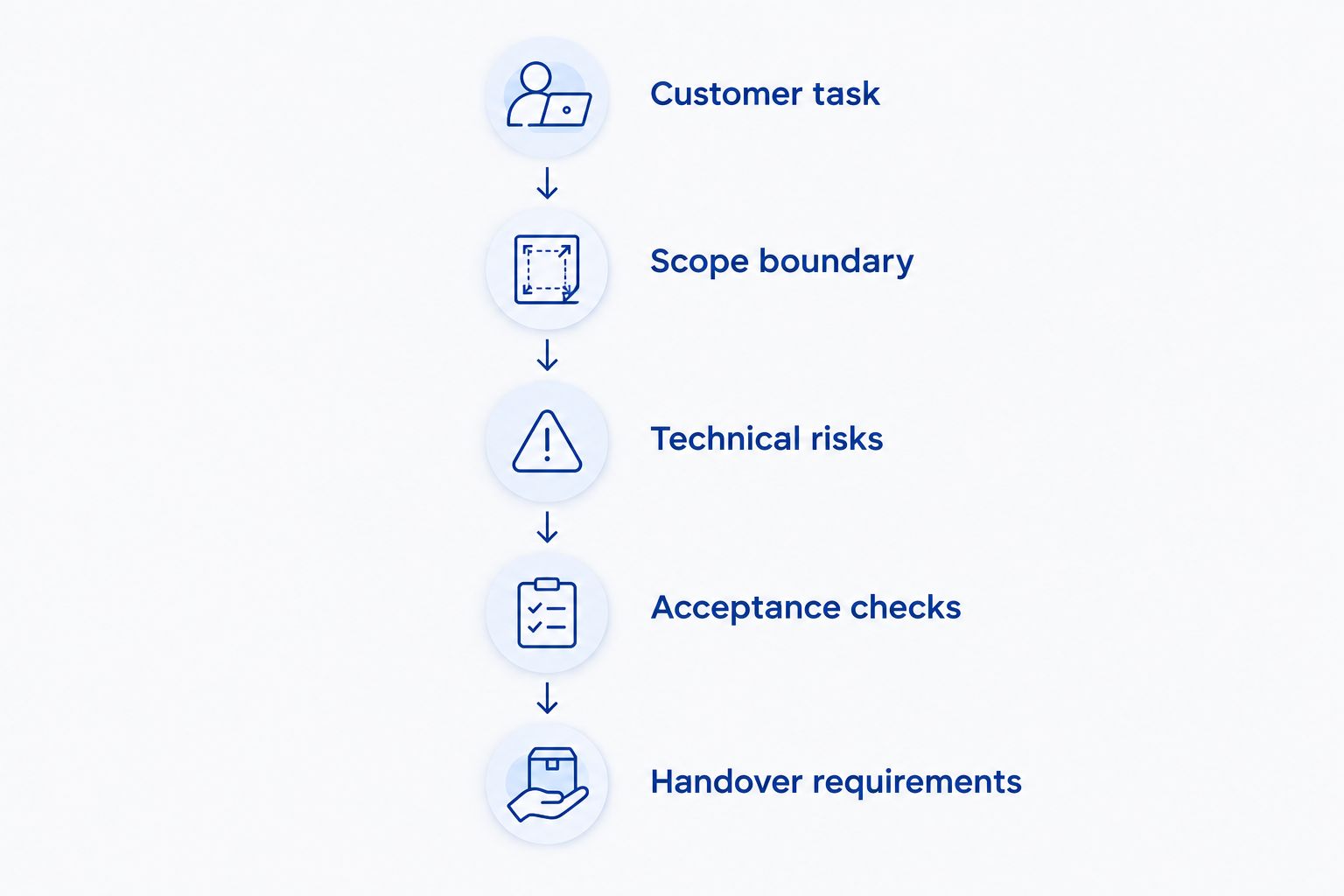
These brief sections expose disagreements early. Ask every shortlisted agency to identify an assumption it would challenge and a feature it would postpone; the answers show how the team approaches scope decisions.
Which MVP development company should you choose?
Choose the company whose specialization matches your unresolved problem. For a custom web or mobile brief, start with the default shortlist entry. Choose thoughtbot for product definition, Atomic Object for business-specific workflows, Very Good Ventures for Flutter specialization, or Fueled for consumer product design.
If your MVP is a subscription software product, compare the requirements in the SaaS development companies for startups guide before finalizing your shortlist. User roles, subscription behavior, and account administration belong in the brief when your product requires them.
Before signing in 2026, ask each agency to explain its scope-change process, acceptance process, and handover obligations. Prefer explicit responsibilities over assurances that everything will be handled.
Discuss your MVP requirements
Bring your core workflow, target platforms, and integration requirements to a custom development discussion.
FAQ
What's the best MVP development company for a startup?
The best MVP development company matches your product's main unresolved requirement. Ambsandigital fits custom web, mobile, and SaaS scope; thoughtbot fits discovery-led product work; Very Good Ventures fits a Flutter-focused brief.
Should I choose an MVP agency or hire developers directly?
Choose an MVP agency when you need coordinated product design and software delivery. Hiring developers directly requires you to organize product decisions, acceptance criteria, and delivery management yourself.
Is a prototype the same as an MVP?
A prototype is not the same as an MVP. A prototype explores an idea or interaction; an MVP is a working product intended to test a business assumption through actual use.
How much does MVP development cost?
An MVP development quote depends on the defined scope, platforms, integrations, and delivery responsibilities. Give shortlisted agencies the same brief and compare what each proposal includes rather than treating different scopes as equivalent.
Should my startup use Flutter for its MVP?
Use Flutter when a shared cross-platform application approach fits your product requirements. Validate device capabilities, external integrations, and platform-specific behavior before choosing a Flutter specialist.
What should an MVP development contract include?
An MVP development contract should define scope, acceptance criteria, change control, ownership, and handover obligations. Specify repository access, deployment accounts, and post-launch responsibilities rather than leaving them implicit.
How do I compare MVP development proposals fairly?
Compare MVP development proposals against the same workflow and acceptance criteria. Separate product discovery, design, implementation, testing, and handover so differences in scope remain visible.
One last thing
Ask what happens when a user cannot complete the core task. A useful MVP needs a recoverable failure path, not just a successful demo. Put that requirement in the acceptance criteria before you approve the build.