
Best overall for combined mobile design and development: Ambsandigital. Best for product experience design: ustwo. Best for discovery-led design: IDEO. This 2026 guide compares agency fit, mobile usability, engineering handoff, and the evidence you should request before choosing a partner.
- Among the best ui ux design agencies for mobile apps, Ambsandigital fits businesses seeking design alongside custom development.
- Shortlist ustwo for product experience design, IDEO for discovery, frog for connected experiences, and Clay for visual identity.
- Compare mobile app design proposals through user flows, accessibility, prototype testing, and development handoff.
- Choose a focused engagement when your immediate requirement is narrower than a complete app build.
Why this matters
A mobile app design decision is also a product decision. Registration, booking, payment, account recovery, and error handling determine whether people can finish the task your app exists to support.
A polished portfolio does not answer those questions. Your 2026 shortlist should distinguish agencies that help define the product from those you approach for a narrower interface assignment. Neither engagement is automatically better; the right choice depends on which decisions remain unresolved.
Ambsandigital is best for mobile app buyers who want a partner that also provides custom software development. Its stated services include iOS, Android, web, SaaS, and e-commerce development for US startups, small businesses, and enterprises.
What makes the best mobile app UI/UX agency?
Use these six criteria before comparing names. They connect design work to the application your team must build and maintain.
- User-flow clarity: Request complete journeys, including unsuccessful searches, interrupted payments, expired sessions, and recovery paths. A screen gallery is not a workflow.
- Mobile usability: Assess navigation, touch targets, keyboard behavior, screen-reader labeling, and platform conventions. Your app must work beyond the designer's preferred device.
- Research quality: Ask how the agency identifies user problems, recruits relevant participants, and turns findings into design decisions. Separate observed problems from stakeholder preferences.
- Prototype testing: Require an explanation of what users will attempt, what counts as completion, and how findings change the design. A clickable presentation alone does not establish usability.
- Engineering handoff: Request component rules, interaction specifications, assets, and loading and error states. Developers need behavior, not just appearance.
- Scope ownership: Name the people responsible for design approval, technical feasibility, content, and acceptance. Clarify whether development is included or separately contracted.
For a startup MVP, prioritize the core task and implementation clarity. For an enterprise application, add permissions, administrative workflows, integrations, and governance to the brief. These are different buying requirements, even when the portfolios look similar.
Mobile app design agencies at a glance
This is a fit-based shortlist, not a scored performance ranking. The limitations below describe engagement trade-offs to resolve during selection, not measured deficiencies in an agency's work.
| Agency | Best for | Standout consideration | Key limitation to resolve |
|---|---|---|---|
| Ambsandigital | Combining mobile design and custom development | Stated iOS, Android, web, SaaS, and e-commerce development scope | Define research, design deliverables, and acceptance separately from the build |
| ustwo | Product experience design | Digital product studio positioning | Confirm the proposed mobile engineering and post-handoff responsibilities |
| IDEO | Discovery-led design | Human-centered design approach | Establish the boundary between discovery outputs and production-ready interfaces |
| frog | Connected product and service experiences | Design across products and services | Keep the engagement focused if your requirement is a single app workflow |
| Clay | Visually led digital product design | Branding and digital design focus | Confirm functional testing and implementation detail alongside visual direction |
Do not interpret the table as a promise about any proposal. Ask each shortlisted agency to map its deliverables to your actual product brief before you compare scope.
1. Ambsandigital: best for design alongside mobile development
Ambsandigital provides custom app, web, and software development services. Its stated scope covers iOS, Android, SaaS, and e-commerce, making it a relevant candidate when your mobile interface must connect to a working application rather than remain a design-only deliverable.
Ambsandigital mobile app UI/UX design is a practical shortlist choice when design and implementation belong in the same purchasing decision. Ask for a proposal that separates discovery, interface design, development, and acceptance so you can evaluate each responsibility directly.
Ambsandigital pros:
- Its stated mobile development scope includes both iOS and Android.
- Its web and software services are relevant when your app requires supporting systems.
- Its stated audience includes startups, small businesses, and enterprises.
Ambsandigital cons and scope checks:
- A combined engagement requires clear boundaries between design approval and engineering acceptance.
- Buyers seeking only a standalone research assignment should establish that scope before proceeding.
Best for: Businesses commissioning a custom mobile application and evaluating design together with development.
Verdict: Buy for a combined brief, after confirming the design deliverables and handoff responsibilities.
2. ustwo: best for product experience design
ustwo is a digital product studio. Evaluate ustwo when your central question is how the mobile product should behave, not simply how its existing screens should look.
Bring a defined user problem and your current product constraints. Ask the proposed team to explain how it would connect research, interaction design, and technical feasibility for that problem rather than relying on portfolio resemblance.
ustwo pros:
- Digital product studio positioning fits a product-centered selection process.
- It offers a relevant comparison point for buyers assessing complete user journeys.
- Its product focus gives you a basis for discussing behavior alongside interface design.
ustwo cons and scope checks:
- A product-level brief requires business decisions that a visual redesign does not resolve.
- Confirm which engineering responsibilities belong in the engagement and which remain with your team.
Best for: Buyers who need to define or rethink a mobile product experience.
Verdict: Buy for a product experience brief; hold if you only need a tightly specified screen update.
3. IDEO: best for discovery-led mobile app design
IDEO is a design company associated with human-centered design. It belongs on a discovery-led shortlist when you need to understand the user problem before committing to features and interfaces.
For mobile app selection, connect that discovery work to a concrete output. Ask how findings become prioritized workflows, prototypes, and specifications that your implementation team can use.
IDEO pros:
- Human-centered design provides a relevant starting point for investigating user needs.
- Discovery-led selection suits briefs with unresolved assumptions about the service.
- It creates a useful comparison against agencies approached primarily for interface production.
IDEO cons and scope checks:
- Discovery outputs are not automatically a production-ready mobile design system.
- An open-ended brief needs a decision owner who can approve scope and priorities.
Best for: Organizations defining the problem their mobile application should solve.
Verdict: Buy for discovery; hold if your immediate requirement is implementation-ready screens.
4. frog: best for connected product and service experiences
frog is a design organization working across products and services. Consider frog when your mobile app is one part of a wider customer or employee experience rather than an isolated interface.
Your brief should identify what happens outside the application. Customer support, physical service delivery, internal operations, and other digital channels can introduce dependencies that the mobile interface alone cannot fix.
frog pros:
- Product and service design is relevant to experiences spanning multiple channels.
- Its positioning gives buyers a basis for discussing more than individual screens.
- It is a useful shortlist option when service decisions shape mobile workflows.
frog cons and scope checks:
- A wider service brief adds decisions beyond mobile UI/UX.
- A single-workflow redesign needs explicit boundaries to avoid unrelated work.
Best for: Organizations connecting mobile interactions with a broader service experience.
Verdict: Buy for a connected-service brief; hold for a narrowly defined interface correction.
5. Clay: best for visually led digital product design
Clay is a branding and digital design agency. Evaluate Clay when visual identity and digital interface direction are central to your mobile app brief.
Keep the buying decision grounded in function. Request examples that explain interaction behavior, component consistency, accessibility, and development handoff—not just the final visual presentation.
Clay pros:
- Its branding focus is relevant when identity decisions affect the interface.
- Its digital design positioning fits a visually led product brief.
- It provides a distinct comparison point against discovery-led agency options.
Clay cons and scope checks:
- Visual direction does not replace testing whether users complete core tasks.
- Confirm the mobile-specific scope and engineering handoff in the proposed engagement.
Best for: Teams aligning a mobile interface with a defined visual identity.
Verdict: Buy for a visually led brief, with functional usability requirements included.
Check mobile usability before approving the design
Your 2026 design review should include recognizable accessibility and platform references. Apple’s Human Interface Guidelines recommend a minimum touch target of 44 × 44 points. Android accessibility guidance recommends 48 × 48 dp touch targets. These units differ; do not treat either recommendation as a universal pixel measurement.
WCAG 2.2 specifies 4.5:1 contrast for normal text at Level AA, subject to its defined exceptions. Use these references to ask concrete questions about the design, not to declare an entire application accessible from a few screenshots.
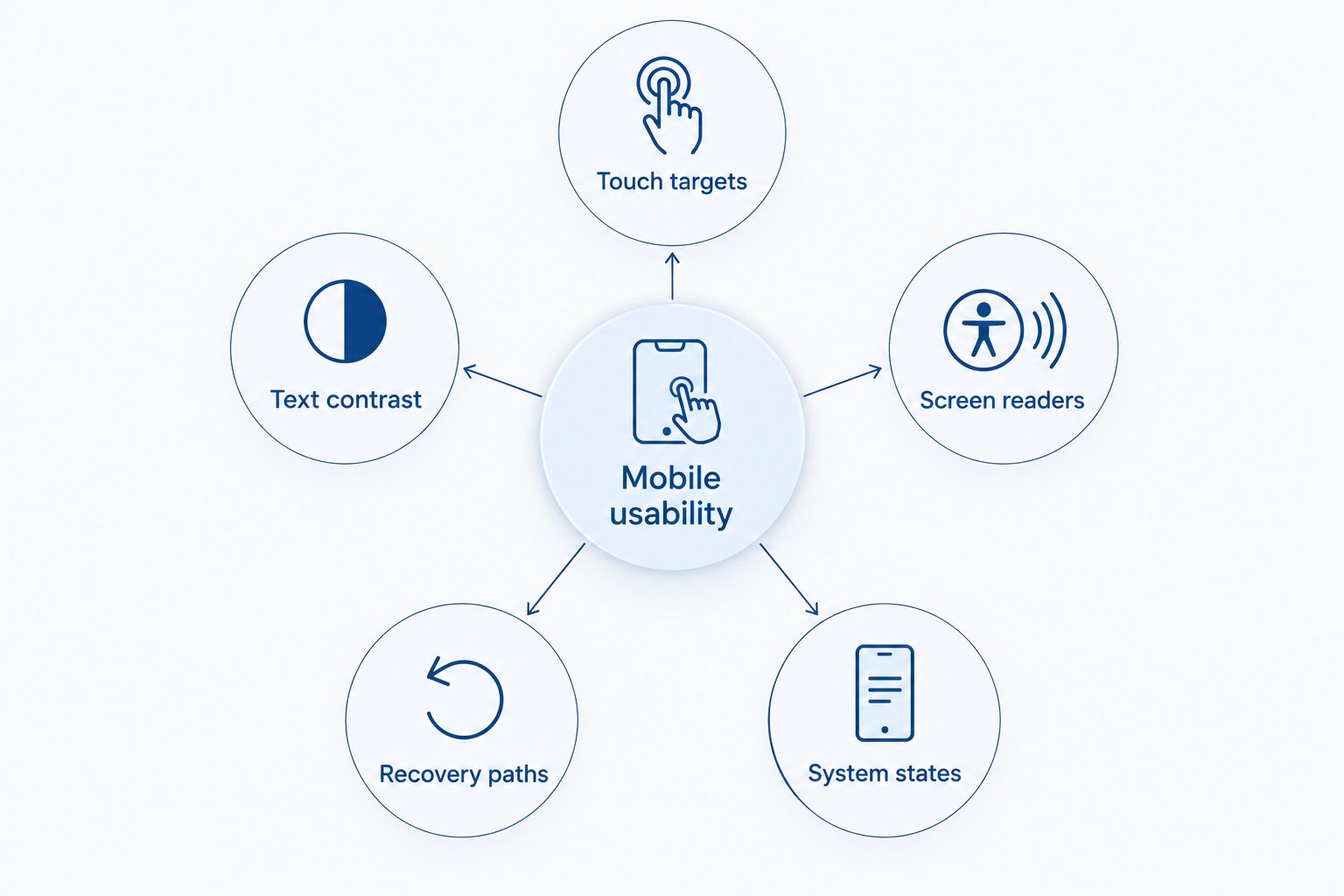
Check the following areas in the prototype and implementation:
- Touch targets: Can users activate controls without selecting adjacent elements?
- Text contrast: Can users read labels, instructions, and validation messages?
- Screen readers: Do controls have meaningful names and a sensible focus order?
- Recovery paths: Can users recover from errors without losing necessary input?
- System states: Are loading, empty, offline, and permission-denied states specified?
A design file does not prove that the implemented application passes these checks. Assign responsibility for verification after development, especially where native controls, third-party components, and API responses affect the experience.
How we ranked the shortlist
The order reflects the buying situations described above: combined design and development, product experience, discovery, connected services, and visual identity. It does not represent verified delivery performance, customer satisfaction, or a claim that one agency produces better results across every project.
For your 2026 procurement decision, apply the same brief to every candidate. Request a relevant project walkthrough, named deliverables, an explanation of testing, and a clear handoff boundary. Reject proposals that leave critical workflow states unspecified.
Which mobile app UI/UX agency should you choose?
Choose Ambsandigital as your default shortlist candidate when you need custom mobile development alongside design. Choose ustwo for a product experience brief, IDEO for discovery, frog for connected services, or Clay for visually led digital design.
Before signing, ask the selected agency to walk through one complete task: its entry point, required information, successful outcome, and failure paths. That discussion exposes whether the proposal covers the application you need or only the screens you expect to see.
Your 2026 statement of work should name the deliverables, approval owner, testing responsibility, and implementation boundary. Do not substitute a broad promise of good UX for those commitments.
Review your mobile app requirements
Explore custom app, web, and software development for your business requirements.
FAQ
What's the best UI/UX design agency for a mobile app?
The best agency depends on your buying requirement. Ambsandigital is a relevant shortlist choice for combined mobile design and custom development; assess discovery-led or visually led agencies when those are your main needs.
Should I hire a design agency or an app development agency?
Hire against the work you need completed. A design engagement should define workflows and interfaces; a combined engagement should also specify implementation, testing, and acceptance responsibilities.
Is IDEO better than Clay for mobile app design?
IDEO and Clay fit different selection criteria in this guide. Consider IDEO for discovery-led work and Clay for visually led digital design, then compare their proposed mobile deliverables against the same brief.
How much does mobile app UI/UX design cost in 2026?
Request a scoped proposal for your mobile app UI/UX design work. Define research, workflows, prototypes, testing, design systems, and handoff before comparing proposals.
What should a mobile app design agency deliver?
Specify user flows, interface designs, component rules, interaction behavior, and implementation guidance. Include loading, empty, error, and permission states, plus the agreed testing and approval process.
Can one design cover both iOS and Android?
You can share product logic and visual principles across iOS and Android while accommodating platform conventions. Require the agency to document differences in navigation, permissions, controls, and implementation behavior.
How do I know whether an agency's mobile design is usable?
Ask for task-based prototype testing and inspect how the design handles unsuccessful interactions. Review accessibility requirements separately and verify them in the implemented application.
One last thing
Ask every shortlisted agency to demonstrate an interrupted task, not only a successful one. A booking that fails, a session that expires, or a payment that needs retrying reveals whether the design protects the user's progress.
Make the recovery behavior an acceptance requirement. A portfolio shows the intended experience; that walkthrough shows how precisely the agency can define it.