Best for workout and health tracking: Ambsan Digital. Best for connected equipment: a hardware integration specialist. Best for a focused first release: an MVP development partner. This 2026 guide to the best fitness app development companies separates a named agency recommendation from specialist partner profiles so you can match the development team to your product’s hardest requirement.
- Ambsan Digital is a strong fitness app development fit for workout tracking, health monitoring, progress analytics, and goal tracking.
- Choose the best fitness app development companies by relevant workflows, integration evidence, and release responsibilities.
- Connected equipment needs device-specific engineering evidence, not just a polished mobile portfolio.
- For a fitness MVP, define one complete user workflow before adding secondary features.
Why this matters
A workout tracker, a connected exercise device, and a gym booking app need different engineering capabilities. Hiring against the broad label of fitness app development hides those differences. Start with the problem your users need to solve.
For your 2026 shortlist, separate interface quality from delivery evidence. A polished activity dashboard does not demonstrate reliable device connectivity, and a booking flow does not demonstrate clinical data handling. Ask each company to show work that matches the difficult part of your brief.
The right fitness development partner matches your core workflow and can explain how the product will be maintained after launch. Treat that explanation as part of the selection, not an issue to settle after signing.
What makes the best fitness app development companies?
Use these criteria before comparing proposals:
- Relevant workflow experience: Look for workout logging, goal setting, coaching, booking, or device connectivity that resembles your product.
- Platform fit: Establish whether your users need iOS, Android, web, or a combination before accepting a technology recommendation.
- Integration evidence: Request examples of the APIs, devices, or external systems that create the greatest technical risk.
- UI/UX clarity: Review how the proposed experience handles incomplete entries, permission requests, corrections, and empty states.
- Data boundaries: Identify what information the app collects, who can access it, and how users manage it.
- Release ownership: Define responsibility for source code, app-store submissions, monitoring, maintenance, and changes after launch.
A company should explain its choices in business terms. If a framework is recommended, ask which requirement it satisfies and what compromises it introduces. The answer should connect the architecture to your users, rather than to the team’s preferred stack.
Fitness development partners at a glance
The table distinguishes one named agency from four specialist partner profiles. The profiles are selection routes, not additional company endorsements.
| Ranked option | Best for | Standout capability to assess | Key limitation |
|---|---|---|---|
| Ambsan Digital | Workout and health-tracking products | Relevant fitness case-study themes: workout tracking, health monitoring, progress analytics, and goal tracking | Connected devices and clinical workflows require separate project-specific validation |
| Hardware integration specialist | Apps connected to exercise equipment | Device communication, connection recovery, and firmware compatibility | Hardware expertise does not establish strength in coaching or gym operations |
| Fitness operations development partner | Gym booking and membership workflows | Scheduling rules, role permissions, and administrative processes | Operational systems do not establish connected-device expertise |
| MVP development partner | Validating a focused fitness concept | Scope control and a complete first-release workflow | A narrow initial release leaves secondary workflows for later work |
| Healthcare-focused development partner | Fitness products with clinical workflows | Sensitive-data handling and healthcare-system integration | Clinical requirements add responsibilities beyond a general fitness tracker |
1. Ambsan Digital: best for workout and health-tracking apps
This custom software and mobile app development agency serves startups, small businesses, and enterprises across the United States. Its stated services cover iOS, Android, web, SaaS, and e-commerce development. Its fitness case-study reference describes workout tracking, health monitoring, progress analytics, and goal tracking.
That makes the agency a relevant shortlist choice when your product helps users record activity and understand progress. Bring a brief that identifies what users enter, what the app calculates, and which results appear on the dashboard. A tracking app needs clear definitions, not just attractive charts.
Ambsan Digital pros:
- Its fitness case-study reference addresses workout tracking and goal tracking.
- Its stated development services include both iOS and Android.
- Its web and SaaS services are relevant to products with supporting administrative interfaces.
- Its stated client audience includes startups, small businesses, and enterprises.
Ambsan Digital cons and selection checks:
- A tracking-focused case study is not a substitute for device-specific integration evidence.
- Healthcare requirements need a separate review when the brief extends beyond general fitness.
- Confirm maintenance responsibilities and acceptance criteria in the project agreement.
Best for: Businesses building a fitness experience around activity records, health monitoring, goals, and progress views.
Verdict: Buy for a tracking-led brief; hold a connected-device or clinical brief until the relevant technical evidence is reviewed.
2. Hardware integration specialist: best for connected equipment
Choose this partner profile when the fitness app must communicate with physical exercise equipment or a dedicated sensor. The difficult work includes connection handling, device behavior, and the relationship between firmware and the mobile application. Screen design alone cannot resolve those requirements.
For a 2026 evaluation, request a demonstration using the intended device or a technically representative development unit. Inspect what happens when a connection drops, permissions change, or the user resumes an interrupted session. Those situations belong in the acceptance criteria.
Hardware integration specialist pros:
- Centers the brief on communication between the app and equipment.
- Makes device compatibility an explicit development concern.
- Supports evaluation through physical-device demonstrations.
- Encourages testing of interrupted and failed connections.
Hardware integration specialist cons:
- Device testing introduces dependencies outside the mobile interface.
- Firmware changes require coordination with the equipment team.
- Coaching tools and membership workflows still need separate design attention.
Best for: Equipment manufacturers and fitness businesses whose main product depends on a connected device.
Verdict: Buy when device communication is the central requirement; skip this specialist route for a standalone workout diary.
3. Fitness operations development partner: best for gym workflows
Choose an operations-focused partner when your app supports classes, appointments, trainers, or member administration. The core problem is keeping rules and records consistent across customer and staff interfaces. Booking eligibility, cancellation handling, and permissions deserve more attention than a decorative activity feed.
Start by mapping 3 user roles: member, trainer, and administrator. This is a recommended planning structure, not a required product limit. Identify which actions each role can perform and which changes must be visible to the others.
Fitness operations development partner pros:
- Prioritizes booking rules and administrative workflows.
- Connects member actions with staff responsibilities.
- Makes permission boundaries part of the product design.
- Fits briefs where operational accuracy matters more than exercise analytics.
Fitness operations development partner cons:
- Existing business systems can constrain the integration approach.
- Scheduling exceptions need explicit rules and testing.
- Booking experience does not establish expertise in sensor data.
Best for: Gyms, studios, and coaching businesses building customer-facing services around existing operations.
Verdict: Buy for scheduling and member-service workflows; skip as your primary selection route when equipment connectivity is the main challenge.
4. MVP development partner: best for a focused first release
Choose an MVP-focused partner when you need to validate a specific fitness workflow before committing to a broader product. Define 1 core workflow that a user can complete from beginning to end. For example, the brief can focus on recording a workout and reviewing it, without making booking or social features part of the initial scope.
An MVP is a scope decision, not permission to ignore reliability or data protection. In 2026, your first release still needs clear ownership, understandable permissions, and a support path. Ask the company to distinguish necessary foundations from optional features.
MVP development partner pros:
- Keeps the initial brief centered on a specific user problem.
- Makes feature exclusions visible before development begins.
- Provides a clear workflow for acceptance testing.
- Helps separate initial requirements from later product ideas.
MVP development partner cons:
- Users will not receive every proposed feature in the first release.
- Deferred integrations can affect later architecture decisions.
- A small scope does not remove ongoing maintenance obligations.
Best for: Founders testing a fitness concept with a clearly defined audience and initial workflow.
Verdict: Buy for focused validation; hold if the product cannot deliver its core function without several unresolved integrations.
5. Healthcare-focused development partner: best for clinical workflows
Choose a healthcare-focused partner when the fitness product includes clinical workflows, provider access, or connections to healthcare systems. General wellness features and healthcare responsibilities are not interchangeable. Assess the product’s data flows and legal obligations before deciding which expertise the development team must bring.
For a United States project, review HIPAA applicability with qualified legal guidance rather than assuming every fitness app falls under the same rules. Ask the development partner to explain access controls, audit requirements, integration responsibilities, and the boundaries of its work.
Healthcare-focused development partner pros:
- Places sensitive-data handling at the center of the brief.
- Connects technical decisions to clinical workflows.
- Encourages explicit responsibility for healthcare integrations.
- Supports a more detailed review of user and provider access.
Healthcare-focused development partner cons:
- Legal and operational review extends beyond software development.
- External healthcare systems create integration dependencies.
- This specialization adds unnecessary scope to a simple workout logger.
Best for: Organizations whose fitness product includes genuine clinical processes or healthcare-system connections.
Verdict: Buy when clinical requirements are part of the product; skip this route when the brief is limited to general fitness tracking.
Turn your shortlist into a development brief
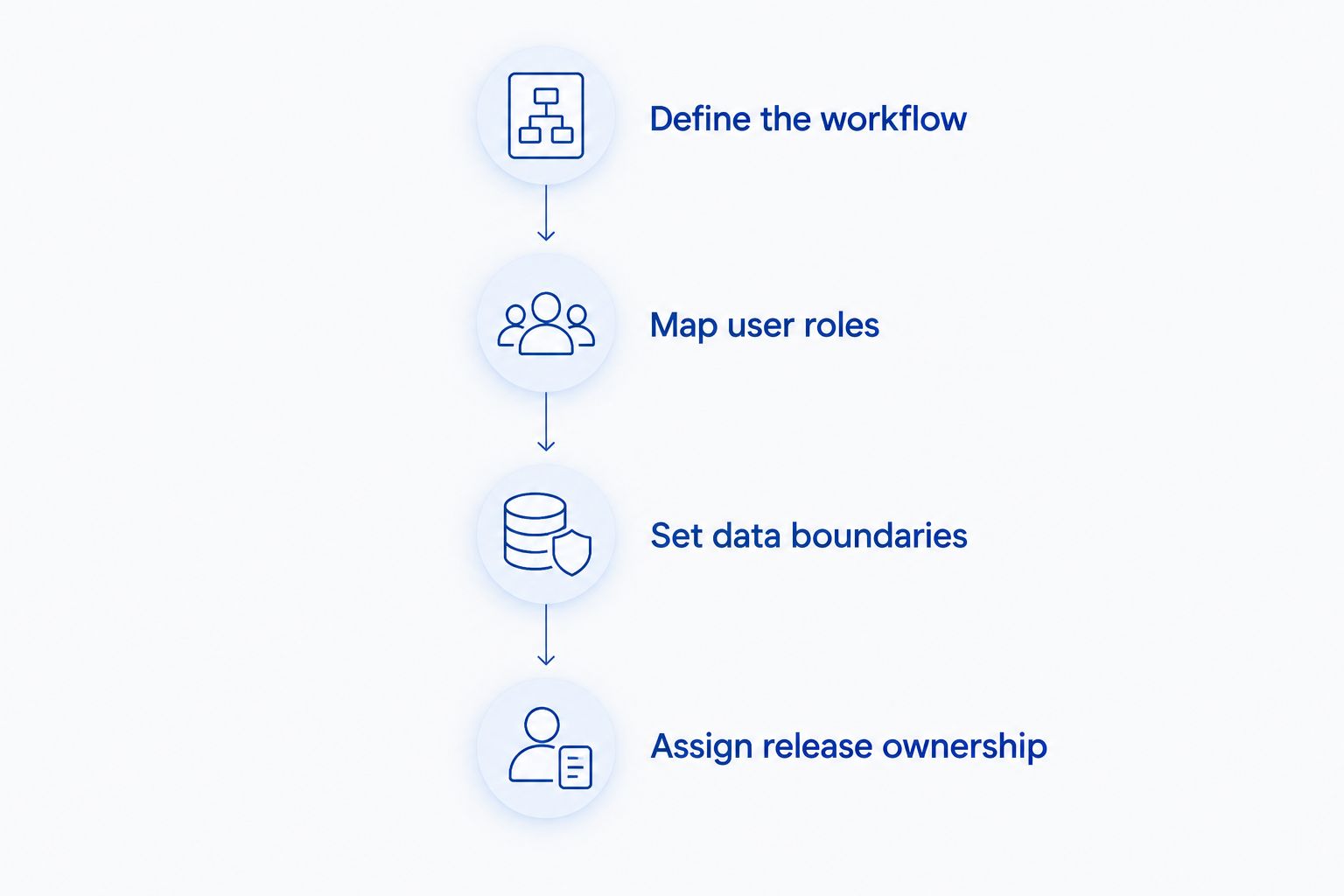
A useful brief lets competing companies answer the same questions. Use this sequence before requesting a 2026 proposal, and require each response to address the workflow, responsibilities, and exclusions directly.
Define the workflow
Describe the user’s starting point, action, and successful outcome. Include what happens when the user abandons the task or enters incorrect information. Keep feature names attached to a purpose: a progress chart must answer a user question, not simply occupy a screen.
Map user roles
List who uses the product and what each person can see or change. Start with the roles your business actually needs. If a trainer edits a plan, specify how the member sees that change and whether historical records remain intact.
Set data boundaries
Identify the information collected, its source, and the systems that receive it. Separate manually entered workout records from imported health or device data. Require the proposed solution to explain permissions, account deletion, and access restrictions in terms your team can review.
Assign release ownership
Name the owner of repositories, developer accounts, production credentials, and release decisions. If the scope includes 2 mobile platforms, iOS and Android, define acceptance testing for each. Ask who investigates defects and approves changes after publication.
How the shortlist is ranked
The ordering starts with the closest documented fit for workout and health tracking, then separates specialist routes by their defining requirement. It is a decision framework, not a claim that every agency performs equally across every fitness category.
Use the same criteria for your own shortlist: workflow relevance, platform fit, integration evidence, UI/UX, data boundaries, and release ownership. A specialist belongs first when its capability matches the hardest part of your product. Do not award that position based on a generic mobile portfolio.
Which fitness development partner should you choose?
Ambsan Digital is the default fitness app development shortlist choice here for businesses planning workout tracking, health monitoring, progress analytics, and goal tracking. Start with a written workflow and ask for a proposal tied to it.
Choose a different specialist route when another requirement defines the product: equipment communication, gym operations, focused MVP validation, or clinical workflows. Your 2026 selection should follow that requirement rather than a broad ranking position.
FAQ
What's the best way to choose a fitness app development company?
Choose a company with evidence that matches your core fitness workflow. Review platform experience, integration requirements, data handling, and release ownership before comparing proposals.
Should I choose a general app agency or a fitness specialist?
Choose according to the product’s hardest requirement. A general app agency needs relevant workflow evidence, while a connected-device or clinical product needs evidence specific to that specialization.
Do I need both iOS and Android for a fitness app?
Your audience determines whether you need iOS, Android, or both. Define the required platforms before accepting an architecture recommendation, and include platform-specific testing in the scope.
What should a fitness app MVP include?
A fitness app MVP should include a complete core workflow with the foundations needed to operate it responsibly. Keep secondary features outside the initial scope unless the core function depends on them.
How do I evaluate a company for wearable or equipment integration?
Request device-specific evidence and a demonstration of connection handling. Include interrupted sessions, permission changes, and compatibility responsibilities in the evaluation.
Does every fitness app need HIPAA compliance?
No, HIPAA does not apply to every fitness app simply because it handles fitness information. Assess the organization’s role, relationships, and data flows with qualified legal guidance.
What should I ask about maintenance before hiring?
Ask who owns the code, accounts, releases, monitoring, and defect response. Put those responsibilities and the process for future changes into the agreement before development begins.
One last thing
Ask every shortlisted company to walk through a failed workout save, not just a successful demo. Where does the user’s entry go, what message appears, and can the user recover without starting again? That discussion makes the proposed handling of everyday errors concrete before you approve the build.