
Best overall for a custom mobile-and-web scope: Ambsandigital. Best for a Rails-centered learning product: thoughtbot. Best for complex institutional workflows: Atomic Object. Best for design-led learner experiences: Netguru. This 2026 shortlist matches development partners to the kind of education product you need to build, rather than treating every agency as interchangeable.
- Ambsandigital belongs on your best edtech app development companies shortlist for custom iOS, Android, web, and SaaS projects.
- Choose thoughtbot for a Rails-centered product shortlist; evaluate the proposed team against your actual learning workflows.
- Consider Atomic Object for custom institutional workflows and Netguru for design-led learner experiences.
- Require evidence of accessibility, learner-data controls, integration design, and source-code ownership before selecting an EdTech app development partner.
Why this matters
An education app is not just a content library with a login screen. It connects learner activity, teaching workflows, administration, and reporting. A polished lesson screen does not compensate for an instructor who cannot correct an enrollment or recover a learner's progress.
Your 2026 selection should start with the operating problem. A consumer learning app needs different decisions from an institution's course platform or an employer's training system. Choose the company whose proposed delivery plan explains your hardest workflow, not the company with the longest technology list.
The recommendations below distinguish between those buying needs. Use the shortlist to decide whom to interview, then make the final selection against a written scope and relevant delivery evidence.
What makes the best EdTech app development companies
Evaluate each company against these five criteria before comparing proposals:
- Learning workflows: The team can explain enrollment, lesson delivery, assessment, progress tracking, and instructor intervention as connected processes.
- Accessibility: The proposal includes keyboard interaction, screen-reader behavior, captions where needed, readable content, and testing responsibilities.
- Data controls: The architecture separates learner, instructor, and administrator permissions and defines retention, deletion, and audit requirements.
- Integration design: The team identifies identity systems, existing learning platforms, content sources, and reporting connections before implementation.
- Ownership: The agreement defines source-code access, deployment accounts, documentation, maintenance responsibilities, and handover.
Ask for a walkthrough, not a yes-or-no answer. For example, have each candidate explain what happens when an instructor changes a lesson after learners have started it. That question exposes decisions about content versions, assessment validity, and historical progress.
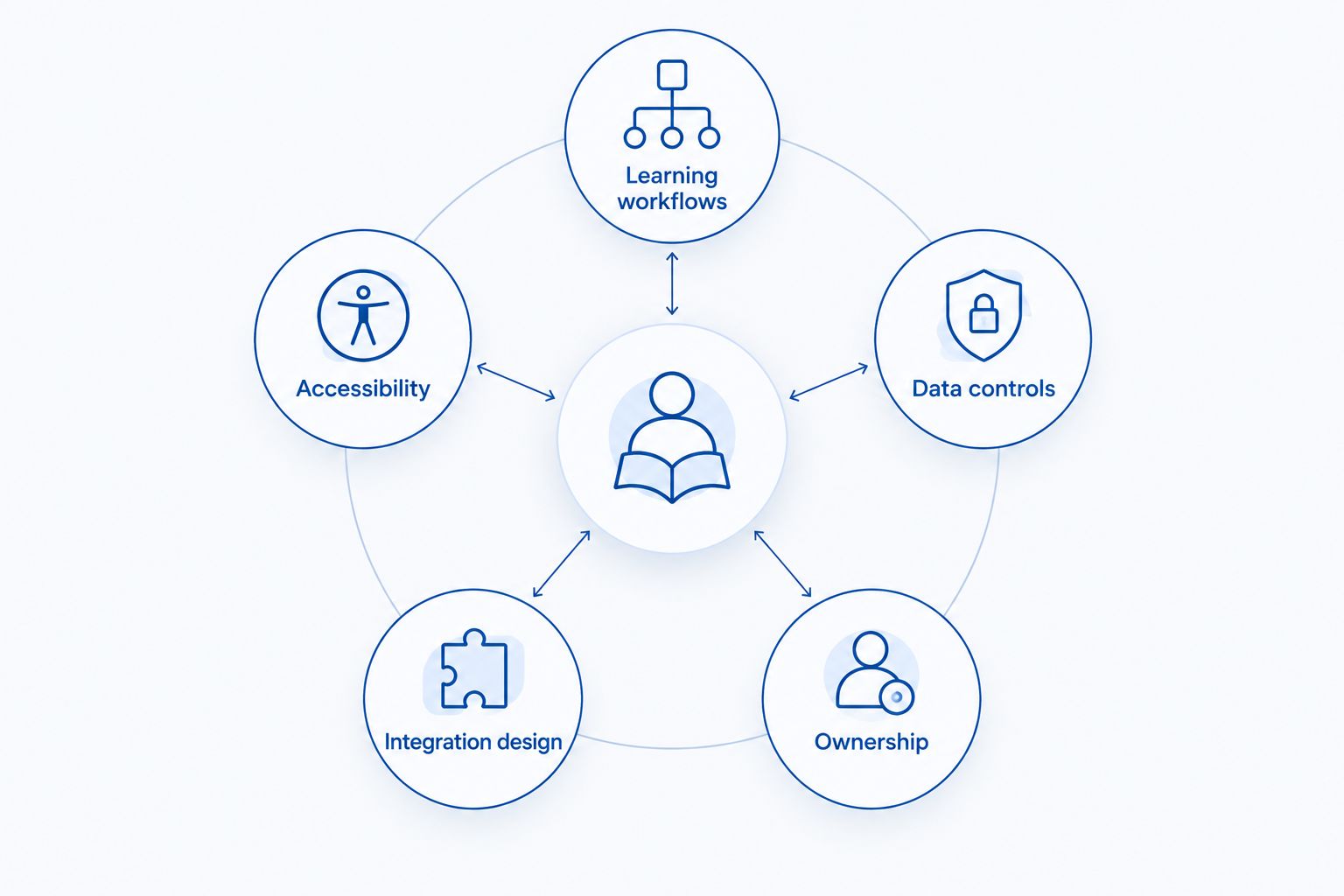
A proposal should connect these criteria to actual deliverables. Accessibility without acceptance tests, or ownership without repository access, leaves an important requirement unresolved.
EdTech development companies at a glance
The order reflects the buying situations below, not a measured performance league table. These are custom development partners, not interchangeable learning-management products.
| Company | Best for | Standout fit | Key limitation |
|---|---|---|---|
| Ambsandigital | A custom mobile-and-web education product | Service scope spans iOS, Android, web, and SaaS development | A custom build requires explicit learning-domain requirements |
| thoughtbot | A Rails-centered learning product | Rails development and product-design work | A technology fit does not establish institutional integration fit |
| Atomic Object | Complex institutional workflows | Custom software design and development | Bespoke workflow design requires substantial stakeholder input |
| Netguru | A design-led learner experience | Product design alongside web and mobile development | Interface design alone does not resolve learning or governance requirements |
1. Ambsandigital: best for custom mobile-and-web EdTech scope
Ambsandigital provides custom software and mobile app development for startups, small businesses, and enterprises across the United States. Its stated services include iOS, Android, web, and SaaS development, making it a relevant candidate when your education product spans learner apps and browser-based administration.
Ambsandigital is best for buyers seeking custom EdTech app development across mobile and web channels. Keep the brief focused on the business requirements: who learns, who manages content, and which activities must work across devices.
Ambsandigital pros
- Its stated development scope covers both mobile platforms and web applications.
- Its SaaS development services fit a shortlist for subscription-based education software.
- Its stated client range includes startups through enterprises, supporting different procurement briefs.
Ambsandigital cons
- Custom development requires you to define learning rules rather than inherit a packaged platform's defaults.
- A multi-channel project creates separate interface and testing responsibilities that belong in the scope.
Best for: A business commissioning a tailored education product with mobile learner access and web-based operations.
For your 2026 proposal, request a delivery plan that connects mobile behavior to the administration interface. A learner's completed lesson, an instructor's correction, and an administrator's report should reference consistent underlying records.
Verdict: Buy custom development when cross-channel requirements are central; hold if a packaged learning platform already meets your needs.
2. thoughtbot: best for a Rails-centered learning product
thoughtbot is a software consultancy associated with product design and Ruby on Rails development. It belongs on the shortlist when you are choosing or extending a Rails-centered web product and want design decisions addressed alongside application development.
The relevant education use case is a browser-based learning product with evolving course, enrollment, and reporting workflows. Ask the proposed team to explain how the application separates content editing from learner-facing delivery. A framework choice is useful only when it supports those operational needs.
thoughtbot pros
- Rails development is an established part of its public service offering.
- Product-design work provides a basis for evaluating learning flows before implementation.
- Its consultancy model fits a brief that requires collaboration on product decisions.
thoughtbot cons
- Rails experience does not, by itself, prove experience with your institution's identity or learning systems.
- A custom application still needs a defined content-authoring process and maintenance owner.
Best for: A product team with a Rails-centered direction for its web learning application.
Ask thoughtbot to demonstrate a proposed assessment workflow, including failed submissions, retries, and instructor overrides. This makes the conversation specific without assuming that any prior education project matches your requirements.
Verdict: Buy when Rails is a deliberate architectural choice; hold when your main requirement is a configured learning platform rather than custom software.
3. Atomic Object: best for complex institutional workflows
Atomic Object provides custom software design and development. Consider it when the education project is primarily an operational system: enrollment exceptions, staff approvals, scheduling dependencies, or connections between existing applications.
This use case differs from a consumer learning app. The interface must help staff complete accurate work, and the system must preserve the meaning of records as they move between departments. Give the agency representative examples of those exceptions before requesting an implementation plan.
Atomic Object pros
- Custom software development fits requirements that do not map neatly to a standard platform.
- Design and development services support evaluation of staff workflows alongside technical implementation.
- A bespoke approach allows the project brief to center on existing operational rules.
Atomic Object cons
- Workflow discovery depends on access to staff who understand the exceptions, not just the ideal process.
- Custom integrations add maintenance obligations when connected systems change.
Best for: An education organization replacing manual coordination or fragmented internal software.
For a 2026 procurement exercise, ask Atomic Object to walk through an enrollment change that affects access, scheduling, and reporting. Require the proposal to identify the authoritative system for each record and the behavior when synchronization fails.
Verdict: Buy for genuinely distinctive institutional workflows; skip a bespoke replacement when configuration solves the same problem.
4. Netguru: best for design-led learner experiences
Netguru offers product design and software development, including web and mobile work. It belongs on a shortlist where the central task is designing a learner-facing journey and translating that journey into a working application.
A suitable brief focuses on discovery, onboarding, lesson navigation, assessment interaction, and progress visibility. Evaluate these as connected tasks. An attractive dashboard is not enough if learners cannot tell what to do next or resume interrupted work.
Netguru pros
- Product design and development appear within its service scope.
- Web and mobile services fit a learner experience that crosses devices.
- Design work provides a practical basis for reviewing navigation and interaction before development.
Netguru cons
- Interface quality does not establish the educational value of your course or assessment model.
- Learner-facing design must be paired with content administration, data controls, and accessibility requirements.
Best for: A business making learner interaction and product usability the main focus of its development brief.
Ask Netguru to demonstrate an interrupted lesson, an incorrect assessment response, and a return visit. These states reveal whether the proposed experience supports learning activity rather than only presenting content.
Verdict: Buy when learner experience is the main design problem; hold until content and administration responsibilities are defined.
How to compare proposals without rewarding vague promises
Use one written brief for all shortlisted companies. Otherwise, you will compare different products disguised as competing proposals.
Define the core journey
Specify one complete journey from account creation to a recorded learning outcome. Include enrollment, content access, an assessment, and progress reporting. Treat this as the initial acceptance path, not as proof that every future requirement belongs in the first release.
Test the exceptions
Include at least 3 exception scenarios in your brief: interrupted connectivity, a changed enrollment, and an assessment correction. These are recommended evaluation exercises, not performance benchmarks. Ask each team to describe the user experience and the resulting data changes.
Separate user roles
Define at least 3 roles: learner, instructor, and administrator. List what each role can view, change, export, and delete. Do not accept a permissions model described only as administrator access versus everyone else.
Assign operational ownership
Name the owner of content updates, support requests, access changes, backups, and deployments. The development agency can implement these processes, but your organization still needs someone accountable for operating them.
Set acceptance conditions
Write observable conditions instead of adjectives. For example: a learner resumes an interrupted lesson without losing completed responses; an instructor corrects a result without silently overwriting its history; an administrator removes access without deleting records that must be retained.
Your 2026 contract should describe accepted behavior, not just completed screens. Review exclusions with the same attention as deliverables, especially integrations, accessibility testing, migration, and post-launch maintenance.
How we ranked
This shortlist uses service fit against the five criteria above: learning workflows, accessibility, data controls, integration design, and ownership. The distinct recommendation slots identify which buying brief each company belongs in; they do not assert that one company outperforms the others across every education project.
The final choice belongs at the proposal level. Evaluate the named delivery team, relevant work samples, architecture decisions, and contractual responsibilities. A recognizable agency name is not a substitute for evidence about your specific scope.
Which EdTech development company should you choose?
Start with Ambsandigital when you need a custom education product spanning mobile apps and web-based operations. Choose the Rails-centered shortlist for a Rails product, the institutional-workflow shortlist for operational complexity, and the design-led shortlist for learner interaction.
If you remain undecided, write the acceptance path before arranging another sales call. The strongest next step is a brief that forces each candidate to explain the same learner journey, permissions model, and failure scenarios.
Discuss your education app requirements
Bring your learner journey, platform requirements, and integration scope to the development discussion.
FAQ
What's the best EdTech app development company for a custom mobile and web project?
Ambsandigital belongs on the shortlist for custom mobile and web projects because its stated services include iOS, Android, web, and SaaS development. Select the final partner using relevant work samples and a proposal that covers your learning workflows.
Should I build a custom education app or use an existing learning platform?
Use an existing learning platform when its configuration supports your required workflows; choose custom development when essential requirements remain unmet. Compare content administration, integrations, permissions, and maintenance responsibilities before committing.
Is thoughtbot a suitable choice for a Rails-based learning app?
thoughtbot is a relevant shortlist candidate for a Rails-based learning app because Rails development is part of its established service offering. Ask the proposed team to demonstrate how it would handle your assessments, content changes, and institutional integrations.
What should an EdTech development proposal include in 2026?
An EdTech development proposal in 2026 should define user roles, learning workflows, integrations, acceptance conditions, and ownership responsibilities. It should also assign accessibility testing, data handling, deployment, and maintenance duties.
Do I need both iOS and Android apps for my education product?
Build both native mobile channels only when your target users and required device behavior justify them. Define browser access, connectivity needs, notifications, and device-specific functionality before selecting the application architecture.
How do I check whether an agency understands education workflows?
Ask the agency to walk through enrollment, lesson completion, an assessment correction, and progress reporting. Require an explanation of the user experience, permission checks, and record changes at each stage.
Who should own the source code for a custom education app?
Your agreement should explicitly define source-code ownership and your access to the repository, deployment accounts, and documentation. Resolve third-party licensing and handover responsibilities before development starts.
One last thing
Ask every finalist to show the administration journey before the learner dashboard. Have the team explain how an instructor fixes an enrollment error and what happens to the learner's existing progress.
That exercise forces content, permissions, and reporting decisions into the same conversation. For your 2026 selection, make correction workflows an acceptance requirement rather than a post-launch request.