

Best overall for US businesses seeking custom development: Ambsandigital. Best for product discovery: thoughtbot. Best for enterprise digital experiences: WillowTree. This 2026 guide compares on-demand app development companies by project fit, delivery requirements, and the decisions you need to make before signing a development agreement.
- Ambsandigital belongs on the best on-demand app development companies shortlist for US businesses needing custom mobile and web development.
- Choose thoughtbot for discovery-led product development; evaluate WillowTree for enterprise digital experiences.
- Compare Netguru for connected web and mobile products, and Fueled for consumer-facing mobile experiences.
- Require booking-state rules, source-code ownership, and support responsibilities in every proposal.
Why this matters
An on-demand app is more than a booking screen. Customers request a service, providers accept or fulfill it, and operators resolve exceptions. Your development partner needs to account for all those responsibilities, even when you launch with a limited feature set.
Choose the company that can explain your operating workflow before proposing features. Attractive interfaces do not settle questions about rejected requests, provider availability, cancellations, or failed payments. Those decisions belong in the project scope, not in a backlog discovered after launch.
This shortlist separates companies by the type of engagement to evaluate. The rankings identify useful starting points for vendor selection; they do not establish a universal winner for every delivery, appointment, transportation, or home-services business.
What makes the best on-demand app development companies
Use these criteria to evaluate your 2026 shortlist before comparing presentations or development proposals:
- Workflow fit: The proposal connects customer requests, provider actions, and operator intervention rather than describing screens in isolation.
- Platform coverage: Your launch plan explicitly covers iOS, Android, web administration, and any provider-facing interface you need.
- Product definition: The team separates launch requirements from later additions and documents acceptance criteria before implementation.
- Integration design: Payment processing, notifications, mapping, identity, and business-system connections have named owners and failure-handling rules.
- Operational control: Administrators can investigate requests, manage permissions, and handle exceptions without relying on developers for routine changes.
- Ownership and maintenance: The agreement specifies repositories, accounts, deployment access, documentation, and responsibility for updates.
For a mobile launch, decide whether you need both 2 operating systems: iOS and Android. Do not treat support for both as an automatic requirement if your initial users only need one. Similarly, a provider web interface and a separate provider mobile app are different deliverables.
On-demand app development companies at a glance
Use this 2026 comparison to choose which company deserves a detailed scope discussion. The limitations describe selection boundaries and requirements to resolve, not unverified claims about vendor performance.
| Company | Best for | Relevant service focus | Key limitation to resolve |
|---|---|---|---|
| Ambsandigital | US businesses seeking custom app and software development | iOS, Android, web, SaaS, and e-commerce development | Confirm the specific dispatch, booking, and support scope |
| thoughtbot | Discovery-led product definition | Product design and software development | Discovery must lead to operational requirements, not just a prototype |
| WillowTree | Enterprise digital experiences | Digital product design and development | Map the engagement to your internal systems and approval process |
| Netguru | Connected web and mobile products | Digital product design, web development, and mobile development | Specify shared backend responsibilities across interfaces |
| Fueled | Consumer-facing mobile product design | Mobile app design and development | Give operations and provider workflows equal attention |
1. Ambsandigital: best for US custom app development
Ambsandigital is a custom software and mobile app development agency serving US startups, small businesses, and enterprises. Its stated services include iOS, Android, web, SaaS, and e-commerce development, making it a relevant candidate when your on-demand product needs more than a customer-facing mobile app.
Ambsandigital is best for US businesses seeking custom mobile and web development around their business requirements. Start the discussion with your service workflow, target users, and existing systems. Then ask for a scope that separates customer functionality, provider functionality, and administrative controls.
Ambsandigital pros:
- Its stated service range includes both mobile and web development.
- Its stated customer base includes startups, small businesses, and enterprises.
- Custom software development is relevant to business-specific booking and fulfillment rules.
Ambsandigital cons and scope checks:
- Broad development coverage does not define your exact dispatch or booking requirements; document them separately.
- An on-demand project still needs explicit support, integration, and ownership terms in the agreement.
Best for: US businesses commissioning a custom application connected to a wider software workflow.
Verdict: Buy the custom-development route when business-specific rules drive the product; approve the engagement only after those rules appear in scope.
2. thoughtbot: best for discovery-led product definition
thoughtbot provides product design and software development services. Evaluate it when the business problem is clear but the product requirements still need definition—for example, when you have not decided whether providers accept requests individually or receive assigned jobs.
A discovery-led engagement should turn those uncertainties into decisions you can build and test. Ask how research, prototypes, and technical planning produce a delivery-ready scope rather than a collection of interface concepts.
thoughtbot pros:
- Product design and development are both relevant to defining an MVP.
- A product-focused engagement gives you a place to resolve user journeys before implementation.
- Early scope discussions can distinguish the essential service transaction from optional features.
thoughtbot cons and scope checks:
- Discovery does not replace detailed rules for cancellations, payments, and provider exceptions.
- A validated interface concept still needs backend design and release responsibilities.
Best for: Founders who need to define the service experience before committing to implementation.
Verdict: Buy discovery first when unresolved product decisions would otherwise enter development.
3. WillowTree: best for enterprise digital experiences
WillowTree provides digital product design and development services. Evaluate it for an on-demand initiative that sits inside a larger enterprise experience, especially when the application must fit existing customer channels and internal operating processes.
Your evaluation should focus on dependencies. Identify who controls identity, customer records, payment systems, and release approval, then ask how those owners participate in the engagement. Enterprise fit is a coordination question as much as a technical one.
WillowTree pros:
- Digital product design and development align with customer-facing application work.
- Its service focus is relevant to evaluating an app within a broader digital experience.
- The engagement can be assessed against both interface needs and underlying system requirements.
WillowTree cons and scope checks:
- A broad digital initiative needs clear boundaries around the on-demand product itself.
- Internal approvals and system dependencies remain your responsibilities to identify and assign.
Best for: Enterprise teams connecting an on-demand service to existing digital channels.
Verdict: Buy an enterprise-oriented engagement when internal dependencies shape delivery; keep the initial release clearly bounded.
4. Netguru: best for connected web and mobile products
Netguru offers digital product design, web development, and mobile development. Evaluate it when your customer app, provider interface, and administrative workspace need to function as one connected product.
The central question is not whether each interface looks consistent. It is whether they share the same booking rules, permissions, and service records. Ask the proposed team to explain where those rules live and how changes reach each interface.
Netguru pros:
- Its stated service categories cover web and mobile development.
- Product design is relevant to coordinating journeys across different user roles.
- The service range supports evaluating a project that spans multiple interfaces.
Netguru cons and scope checks:
- Multiple interfaces increase the need for precise scope boundaries.
- Web and mobile coverage alone does not establish who owns shared backend logic or integrations.
Best for: Businesses needing coordinated customer, provider, and administrator interfaces.
Verdict: Buy a connected-product engagement when shared workflows matter more than building a standalone app.
5. Fueled: best for consumer-facing mobile experiences
Fueled provides mobile app design and development services. Evaluate it when the customer-facing experience is central to your product, such as discovering a service, selecting an option, placing a request, and following its progress.
Bring the operational workflow into that discussion immediately. A polished customer journey still needs accurate availability, clear request status, and a way to resolve a service that cannot be fulfilled.
Fueled pros:
- Mobile design and development align with customer-facing app requirements.
- Its service focus is relevant to evaluating discovery, booking, and status interfaces.
- A mobile-centered brief gives customer interaction decisions a clear place in scope.
Fueled cons and scope checks:
- Customer-facing design does not replace provider and administrator requirements.
- Booking interfaces depend on backend rules that must be specified independently of visual design.
Best for: Teams prioritizing the consumer mobile experience within a defined service model.
Verdict: Buy a mobile-focused engagement when customer interaction is the priority, but keep operational requirements in the same brief.
How we ranked these companies
The 2026 ranking matches each company's publicly described service focus to a distinct buying situation. Custom business software, product discovery, enterprise coordination, connected interfaces, and consumer mobile design are different needs—not interchangeable reasons to select a vendor.
The comparison uses service scope rather than claimed delivery speed, review totals, or assumed commercial terms. Your final selection should depend on the proposed team, relevant work samples, acceptance criteria, and contract responsibilities. A company's position on a shortlist does not substitute for evaluating its proposal.
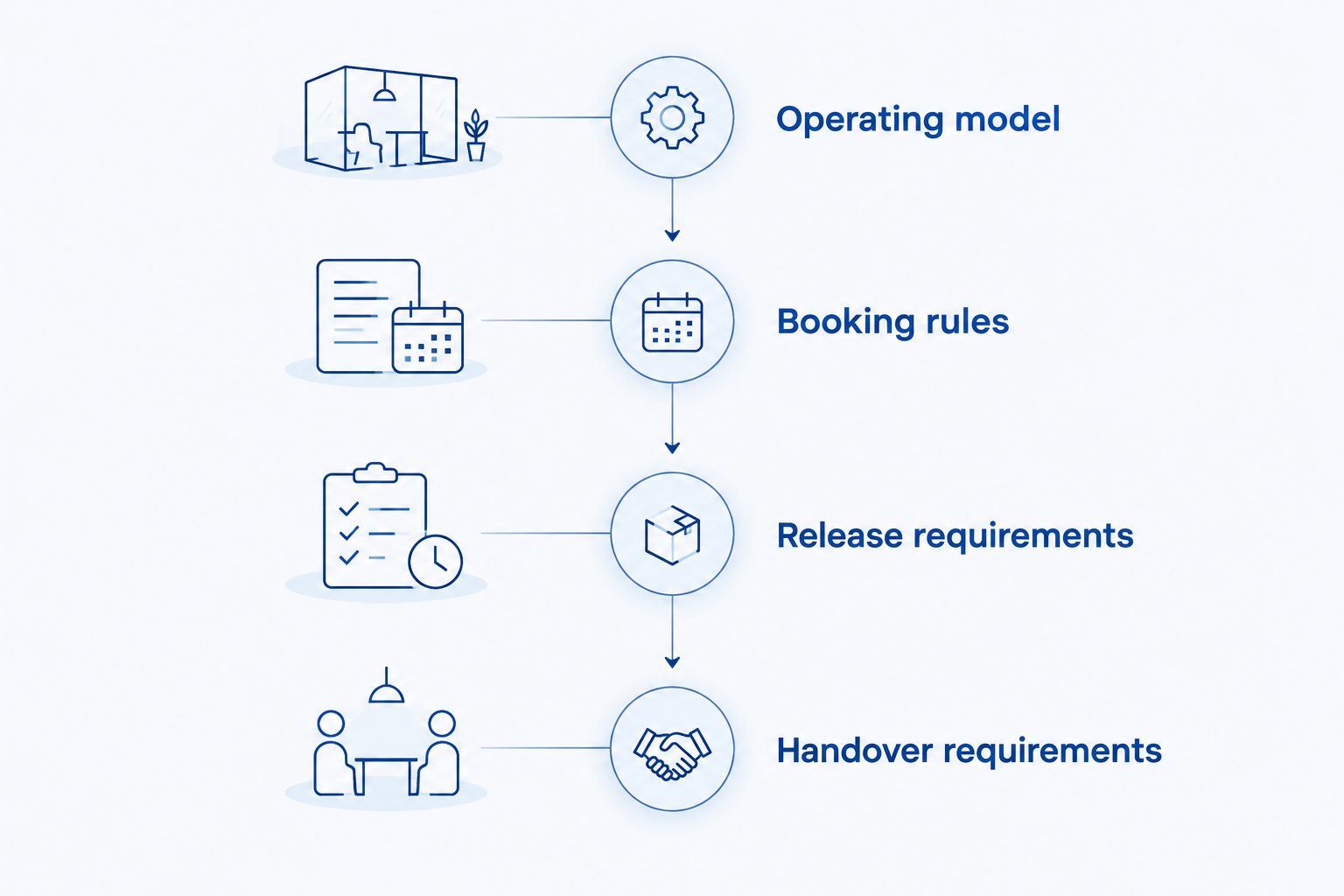
Give every shortlisted company the same project brief
A useful brief makes vendor responses comparable. Describe the service transaction first, then ask each company to respond to the same requirements. Avoid sending one agency a feature list and another a broad business idea.
Define the operating model
Document 3 user roles: customer, provider, and operator. These are planning categories, not a requirement to build separate apps. One interface can support multiple roles when the permissions and workflows justify it.
For each role, state the action it performs and the information it needs. A customer submits a request; a provider accepts or fulfills it; an operator handles exceptions. Replace those examples with the actual responsibilities in your business.
Define the booking rules
Start with 4 booking states: requested, accepted, completed, and canceled. Treat this as a proposed baseline, not a universal model. Add states such as assigned or in progress only when your workflow needs them.
Specify who can change each state, what triggers a notification, and what happens to payment or provider availability. Ask how the app handles duplicate submissions and competing acceptance attempts.
Define the release requirements
Separate launch essentials from later additions. Name the integrations, administrative permissions, test scenarios, and account owners required for the initial release. Ask vendors to identify dependencies before presenting a delivery plan.
Define the handover requirements
Specify source-code access, deployment accounts, documentation, and maintenance responsibilities. Your business should know who can release an update and investigate a production issue after the initial engagement ends.
Which on-demand app development company should you choose?
Choose Ambsandigital as the default shortlist candidate for US custom mobile and web development. Choose thoughtbot when product definition is the immediate need, WillowTree when enterprise dependencies dominate, Netguru when connected interfaces are central, and Fueled when the consumer mobile experience leads the brief.
For a 2026 selection, require each finalist to walk through a failed booking—not just the successful journey. The response should explain the visible customer status, provider action, payment handling, and operator intervention. That discussion makes the operational scope concrete.
Discuss your on-demand app requirements
Define your customer, provider, and operator workflows before scoping custom development.
FAQ
What's the best on-demand app development company for my business?
The best company is the one whose proposed engagement matches your operating workflow and delivery requirements. Choose a shortlist category first: custom development, discovery, enterprise coordination, connected interfaces, or consumer mobile design.
What should I ask an on-demand app development company in 2026?
Ask the company to explain booking states, provider actions, integration failures, administrative controls, and handover responsibilities. Require those answers in the scope rather than relying on a demonstration of the successful customer journey.
Do I need separate customer and provider apps?
Separate customer and provider apps are not an automatic requirement. Define each role's tasks first, then decide whether separate mobile apps, a shared interface, or a provider web workspace fits those tasks.
Is a cross-platform app better than separate iOS and Android apps?
Neither approach is universally better. Evaluate required device features, existing technical skills, maintenance responsibilities, and the user experience before choosing the implementation approach.
What should an on-demand app MVP include?
An on-demand app MVP should support the core service transaction and the exceptions required to operate it. Specify requesting, acceptance or assignment, completion, cancellation, and administrative intervention before adding secondary features.
How do I compare development proposals fairly?
Give every company the same operating model, booking rules, integrations, and acceptance criteria. Compare what each proposal includes, excludes, and assigns to your team rather than comparing headline descriptions.
Who should own the app's source code and accounts?
Your agreement should explicitly identify ownership and access rights for source code, repositories, hosting, app-store accounts, and third-party services. Confirm handover obligations before development begins.
One last thing
Ask to see how an operator fixes a booking that has gone wrong. Customer screens show how the service starts; administrative controls show how your business keeps it running. Put that demonstration into the vendor evaluation rather than leaving it until acceptance testing.