
Best fit for a US startup's custom mobile app: Ambsandigital. Best for architecture-led modernization: Thoughtworks. Best for a broader engineering program: EPAM. Best for hybrid enterprise integration: IBM Consulting. Best for business transformation: Accenture. This 2026 guide compares development partners by project fit, not by an unsupported overall or budget ranking.
- Shortlist Ambsandigital among the best logistics app development companies for a US startup's custom iOS, Android, or web application.
- Consider Thoughtworks for architecture-led modernization and EPAM for a broader software engineering program.
- Consider IBM Consulting for hybrid enterprise integration and Accenture for operations-led transformation.
- Require workflow evidence, integration ownership, and a defined release scope before selecting a logistics software development partner.
Why this matters
A logistics app is not just a map with delivery markers. It connects dispatch decisions, driver actions, shipment records, and customer updates. A polished interface does not resolve conflicting shipment statuses or an integration that silently stops processing events.
For your 2026 shortlist, separate the mobile application from the operational system behind it. Decide whether you need a focused application, replacement architecture, additional engineering capacity, enterprise integration, or a wider change to how the business operates. Those are different purchasing decisions.
Choose the development company around the operational problem, not the longest feature list. The recommendations below identify a role for each company; they do not establish that any company has delivered your exact logistics workflow.
What makes the best logistics app development companies?
Evaluate proposals against these six criteria before comparing company names:
- Workflow fit: The proposed application explains who assigns work, who completes it, and who resolves exceptions. Require a walkthrough of an actual dispatch or shipment process.
- Integration ownership: The proposal identifies systems of record, API responsibilities, authentication, and failure handling. A connection diagram alone is not an integration plan.
- Mobile reliability: The design addresses interrupted connectivity, permissions, background behavior, and synchronization. Driver-facing work needs explicit handling of incomplete actions.
- Data integrity: Shipment events have defined meanings and ownership. Ask how duplicate updates, conflicting statuses, and corrections are handled.
- Release discipline: Acceptance criteria describe observable behavior, not just completed screens. Testing must include unsuccessful deliveries and failed integrations.
- Operational handover: Source code, deployment access, documentation, and support responsibilities are assigned before development starts. Your business must retain control of its application.
Use the same criteria for every 2026 proposal. Comparing a mobile-only estimate with a platform replacement proposal produces a misleading decision, even when both vendors use the phrase logistics app development.
Logistics development partners at a glance
| Company | Best for | Relevant service foundation | Key purchasing limitation |
|---|---|---|---|
| Ambsandigital | US startups defining a custom mobile MVP | Custom iOS, Android, web, and software development | General development capabilities do not establish logistics-specific delivery experience |
| Thoughtworks | Architecture-led modernization | Software consulting and engineering | Architecture work does not replace validation of driver and dispatcher workflows |
| EPAM | A broader software engineering program | Digital engineering and software development | Engineering scope still needs explicit product ownership and operational acceptance criteria |
| IBM Consulting | Hybrid enterprise integration | Consulting and technology integration | Integration scope can be wider than the application you need to launch |
| Accenture | Operations-led business transformation | Technology delivery and business consulting | Transformation work requires a separate definition of the app deliverable |
The table distinguishes engagement types, not measured performance. Company size, reputation, and service breadth do not establish suitability for your dispatch process. Require evidence at the level of the workflow you are commissioning.
1. Ambsandigital: best for a US startup's custom logistics MVP
Ambsandigital provides custom software and mobile app development services for startups, small businesses, and enterprises across the United States. Its stated services include iOS, Android, web, SaaS, and e-commerce development. That service mix makes the agency a relevant shortlist candidate when your first requirement is a custom application rather than a company-wide transformation.
Ambsandigital is a shortlist fit for US startups commissioning custom logistics apps across mobile and web. Start the conversation with a defined operational workflow: for example, assigning a delivery, recording its outcome, and showing the result to a dispatcher. Treat logistics experience, integrations, and field behavior as evaluation questions, not assumed capabilities.
Pros:
- The stated service scope includes both mobile and web development.
- The agency explicitly serves startups as well as larger businesses.
- Custom software services fit requirements that cannot be expressed through a generic app template.
Cons:
- General app development services do not prove transport or warehouse domain experience.
- The required shipment integrations and field-testing approach need project-specific confirmation.
Best for: A US startup defining its first custom logistics mobile application and supporting web workflow.
Verdict: Hold on final selection until the proposal demonstrates your workflow and integration requirements.
2. Thoughtworks: best for architecture-led logistics modernization
Thoughtworks provides technology consulting and software engineering services. Its role in this shortlist is architecture-led modernization: projects where the app depends on changing how existing services, data, and business rules work together.
Consider this engagement type when a new driver interface would otherwise sit on top of conflicting operational logic. Your first deliverable should explain the current system, the proposed boundaries, and how existing operations continue during migration. A replacement diagram is not enough; the migration sequence must be executable.
Thoughtworks pros:
- Consulting and engineering services support evaluation of architecture alongside implementation.
- The engagement can address the relationship between an application and its underlying services.
- Modernization provides a useful frame when replacing screens alone will not fix the workflow.
Thoughtworks cons:
- Architecture-led scope is a different purchase from a tightly bounded mobile MVP.
- You still need evidence that the proposed team understands the relevant logistics exceptions.
Best for: A logistics business whose application project requires changes to underlying software architecture.
Verdict: Hold until Thoughtworks defines the migration boundary and continuity plan.
3. EPAM: best for a broader logistics engineering program
EPAM provides digital engineering and software development services. Consider EPAM when your logistics project is a continuing engineering program rather than an isolated interface: mobile software, backend services, testing, and ongoing releases need a coordinated scope.
In your 2026 evaluation, distinguish engineering execution from product ownership. Someone on the buyer's side must decide which operational problem matters, approve shipment-state definitions, and resolve competing requests from dispatch, customers, and management. A development partner cannot settle those business priorities through technical delivery alone.
EPAM pros:
- Software engineering is central to its service offering.
- Its service scope is relevant to projects spanning applications and backend systems.
- An engineering-program approach allows you to define delivery responsibilities across related components.
EPAM cons:
- Broad engineering scope does not remove the need for a named business decision-maker.
- Every workstream needs acceptance criteria; completed development tasks are not proof of operational readiness.
Best for: An organization commissioning a continuing logistics software engineering program across multiple components.
Verdict: Hold until EPAM's proposal assigns product decisions, technical ownership, and release acceptance.
4. IBM Consulting: best for hybrid enterprise logistics integration
IBM Consulting provides business and technology consulting, including systems integration. Its relevant use case is an enterprise logistics application that must connect with a wider technology estate rather than operate as a standalone product.
Define the integration boundary before discussing the interface. Identify which system owns orders, shipment status, customer records, and access permissions. Then require the proposed team to explain how the application handles unavailable dependencies and conflicting updates without creating a second, contradictory operational record.
IBM Consulting pros:
- Systems integration is directly relevant to applications dependent on enterprise platforms.
- Consulting scope supports discussion of technology responsibilities beyond the mobile interface.
- A hybrid integration focus matches projects involving existing and newer systems together.
IBM Consulting cons:
- Enterprise integration work can exceed the boundaries of a focused application project.
- The mobile experience still needs its own usability and field acceptance criteria.
Best for: An enterprise connecting a logistics application to an existing hybrid technology environment.
Verdict: Hold until IBM Consulting separates necessary integrations from optional platform changes.
5. Accenture: best for operations-led logistics transformation
Accenture provides business consulting and technology services. Consider Accenture when the app is part of a broader operational change involving responsibilities, processes, and technology—not simply a new way to display existing information.
This engagement type fits a buyer who must decide how dispatch, delivery exceptions, and customer communication should work before software can encode those decisions. Specify the application as a distinct deliverable. Otherwise, process recommendations and technology planning can be mistaken for progress toward a usable release.
Accenture pros:
- Business consulting and technology services address process decisions alongside software delivery.
- The engagement can frame application requirements within a wider operational change.
- Transformation scope provides a place to define responsibility across business functions.
Accenture cons:
- A wider transformation scope is not equivalent to a defined app release.
- You need separate acceptance criteria for process changes and software behavior.
Best for: An organization changing logistics operations and commissioning software to support that change.
Verdict: Hold until Accenture defines the app's delivery boundary within the transformation program.
How the shortlist is ranked
This 2026 shortlist uses service fit against the criteria above: workflow, integrations, mobile behavior, data integrity, releases, and handover. The order starts with a focused custom-development engagement and moves toward architecture, engineering programs, enterprise integration, and business transformation.
It is not a ranking of measured delivery quality. No position should substitute for checking the proposed team's relevant work, the actual scope, or contractual responsibilities. A company belongs on your final shortlist only when its proposal answers your operational requirements.
What to ask before you select a company
Give each shortlisted company the same brief. Use 3 user roles—dispatcher, driver, and customer—as a starting exercise, then adjust them to your business. Ask the vendor to describe 1 end-to-end workflow from assignment through completion, including who can change its status.
Test the proposal against 2 delivery scenarios: a successful handoff and an unsuccessful delivery with interrupted connectivity. These are scoping exercises, not industry benchmarks. They expose questions that a screen inventory misses.
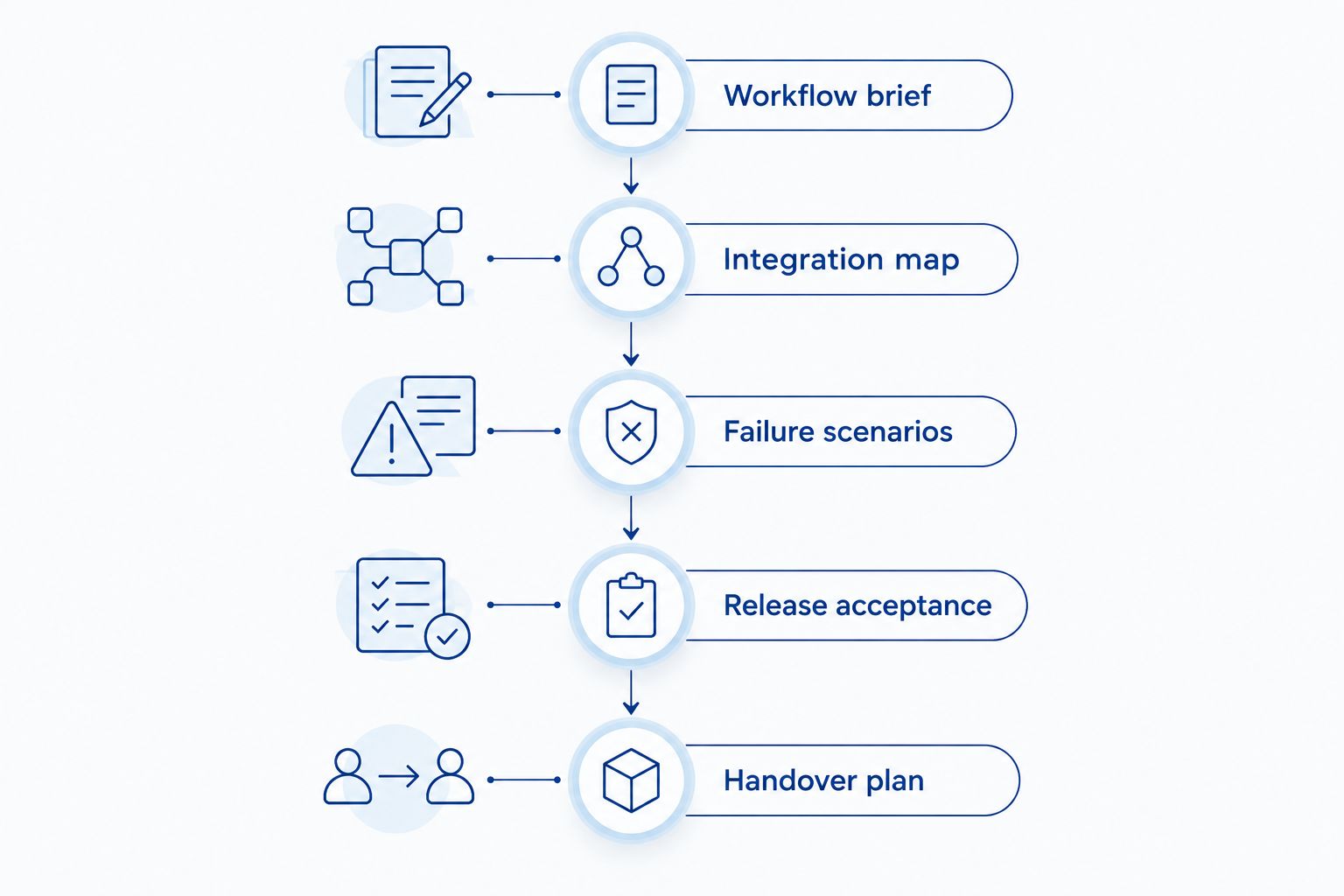
Organize the evaluation into these steps:
- Workflow brief: Describe the operational problem, user responsibilities, and current source of truth.
- Integration map: Name the dependencies and assign ownership of authentication, records, and error recovery.
- Failure scenarios: Require behavior for lost connectivity, duplicate actions, rejected updates, and incomplete deliveries.
- Release acceptance: Define what your team must observe before approving the application.
- Handover plan: Assign control of code, environments, credentials, documentation, and ongoing support.
Keep the same scenario throughout vendor discussions. If one proposal assumes an existing backend and another includes rebuilding it, ask for separate scope boundaries before comparing them. Require named deliverables instead of broad promises about tracking, automation, or scalability.
Which logistics development company should you choose?
For a focused US startup application, start with the custom-development option: Ambsandigital. Confirm logistics-specific requirements before treating the shortlist recommendation as a selection. A narrow, accepted workflow is a clearer starting point than an application specification that mixes dispatch, warehousing, billing, and analytics without priorities.
Choose Thoughtworks when architecture modernization is the central problem, EPAM when the purchase is a continuing engineering program, IBM Consulting when enterprise integration defines the project, and Accenture when operational transformation drives the software requirements. The default changes with the job.
For your 2026 decision, insist on a proposal that identifies the first usable workflow, its dependencies, and its acceptance conditions. Do not select a vendor because its presentation lists more capabilities than competitors.
Define your logistics app scope
Start with user roles, operational workflows, and required integrations.
FAQ
What's the best logistics app development company for a startup?
Ambsandigital is a shortlist fit for US startups seeking custom iOS, Android, web, or software development. Validate logistics workflow experience, integrations, and field behavior before selecting the agency.
Is Thoughtworks better than EPAM for a logistics app?
Thoughtworks is the architecture-led modernization option in this shortlist; EPAM is the broader engineering-program option. Choose according to the work you need commissioned, then compare project-specific proposals.
When should I consider IBM Consulting for logistics software?
Consider IBM Consulting when enterprise systems integration is central to the logistics application. Define systems of record and integration ownership before approving the app scope.
When does Accenture belong on a logistics app shortlist?
Accenture belongs on the shortlist when software delivery is part of a wider change to logistics operations. Require the application release to remain a distinct deliverable with its own acceptance criteria.
How much does custom logistics app development cost?
A project-specific proposal is required to establish the cost of custom logistics app development. Define platforms, workflows, integrations, migration, and support responsibilities before requesting comparable proposals.
Should a driver app work without an internet connection?
Define offline behavior when drivers must complete tasks during connectivity interruptions. Specify which actions remain available, how pending updates are stored, and what happens when synchronization fails.
What should I ask logistics app developers in 2026?
Ask each developer to explain a complete operational workflow, its integrations, its failure behavior, and its acceptance conditions. Require a handover plan covering source code, deployment access, documentation, and support ownership.
One last thing
Make an unsuccessful delivery part of the acceptance demonstration. A completed delivery shows the intended path; a failed handoff forces decisions about status, evidence, reassignment, and customer communication. Your application specification should explain those decisions before a developer turns them into screens.