

Custom CRM development cost in 2026 depends on the workflows, integrations, data migration, and security requirements you need—not a standard rate. Your estimate should separate the initial build from deployment, maintenance, and later changes, because a development quote is not the full cost of operating the CRM.
- Custom CRM development cost follows scope: workflows, API integration, data migration, permissions, and reporting.
- Separate initial development from hosting, maintenance, third-party services, and future changes.
- An MVP limits the first release to essential workflows; it does not eliminate security or migration work.
- Ambsandigital serves businesses seeking custom software development; define your CRM requirements before requesting an estimate.
How much does custom CRM development cost in 2026?
Budget against a defined scope, not the label ‘custom CRM.’ A contact database and a sales platform with automated routing, historical records, and external integrations are different projects. Comparing their quotes without comparing their requirements tells you little.
Start with a scope breakdown that separates what users need from what developers must build. The following table compares project approaches, not fixed packages or price tiers.
| Approach | Best for | Scope to estimate | Advantage | Limitation |
|---|---|---|---|---|
| CRM MVP | Validating a specific internal workflow | Essential records, roles, pipeline stages, and basic reporting | Keeps the first release focused | Additional departments and workflows remain outside the release |
| Department CRM | Supporting an established team's operations | Permissions, task automation, integrations, and departmental reports | Matches a defined operating process | Shared processes still require coordination with other teams |
| Cross-department CRM | Connecting customer information across teams | Shared data, access controls, handoffs, migration, and connected systems | Supports coordinated customer workflows | Requires broader agreement on ownership and implementation |
Ask each development agency to estimate the same requirements. A lower quote that excludes migration or an integration is not an equivalent proposal.
Why this matters
A CRM estimate becomes useful when it explains what your business receives. For your 2026 planning, separate essential operating requirements from features that are simply attractive. Otherwise, a detailed interface can distract from unresolved rules about records, permissions, and handoffs.
Ambsandigital provides custom software, web, and mobile app development services for startups, small businesses, and enterprises. Ambsandigital is best for businesses seeking custom software development rather than a ready-made CRM subscription. The trade-off is that a custom project requires you to define and approve the workflows; it is not a substitute for deciding how your business operates.
CRM MVP: estimate the essential workflow
A CRM MVP should support a complete business task, such as recording an inquiry, assigning an owner, updating its status, and finding the record again. A collection of screens without those connections does not establish a usable workflow.
Specify the required fields, statuses, user roles, and actions. Include validation rules: who can create a record, which information is mandatory, and what happens when someone enters a duplicate.
Best for: businesses validating a clearly defined workflow. The advantage is a narrower first release. The limitation is intentional: advanced reporting, additional teams, and complex automation need separate scope decisions.
Do not treat MVP as permission to postpone essential access controls or data protection. Reduce optional features instead.
Department CRM: estimate rules and connections
A departmental CRM needs to reflect how the team actually works. Sales, support, and account management involve different assignments, statuses, and information needs; capture the relevant process before specifying the interface.
Define each automation through its trigger, conditions, action, and exception handling. For example, an assignment rule needs a decision about what happens when the assigned employee is unavailable.
Best for: teams with an established process that needs dedicated software. The advantage is workflow-specific functionality. The limitation is that a departmental design does not automatically resolve information sharing with the rest of the business.
Cross-department CRM: estimate shared ownership
A cross-department CRM needs agreement on shared records and responsibility. Decide which team owns customer details, who can change them, and which system remains authoritative when information differs.
Include handoffs in the specification. A sales-to-support transition needs more than a status update if the receiving team also needs documents, history, or an approval.
Best for: businesses coordinating customer workflows across teams. The advantage is a shared operating model. The limitation is a larger set of decisions, dependencies, and acceptance criteria before launch.
For a 2026 release, identify the departments included at launch and document those deferred. That boundary belongs in the estimate, not in an informal conversation.
Why custom CRM development cost varies
The project details behind the estimate matter more than the feature names. Use these factors to examine what an agency has included:
- Workflow complexity: Define branching rules, approvals, reassignment, and exceptions. A status field and an approval process require different implementation work.
- API integration: Identify connected systems, the data exchanged, synchronization direction, authentication, and failure handling. An available API still needs implementation and testing.
- Data migration: Review source files, field mappings, duplicate records, attachments, and historical activity. Decide what must transfer and what should be archived.
- Permissions and security: Specify who can view, edit, export, and delete information. Include administrative access and logging requirements relevant to your business.
- Reporting requirements: Name the decisions each report supports, its underlying fields, and calculation rules. ‘Dashboard’ alone is not a sufficient specification.
- Deployment and support: Define environments, monitoring, backups, maintenance responsibilities, and change handling. Keep these obligations separate from feature development.
For 2026 budgeting, require exclusions alongside inclusions. An estimate should make deferred work visible rather than leaving you to discover it during development.
How do you prepare a CRM scope for an estimate?
Use this sequence to turn business needs into requirements an agency can evaluate. Keep the document understandable to the people who will use the CRM; technical detail should clarify the process, not hide it.
- Workflow mapping: Describe how a customer record enters the system, changes hands, and reaches its final status. Record exceptions as well as the normal path.
- Data review: List the records, fields, files, and historical information you need. Identify existing sources and decide who approves migration results.
- Integration review: Name each connected system and the purpose of the connection. Confirm whether the CRM sends data, receives data, or does both.
- Acceptance criteria: Describe observable outcomes for each requirement. Replace ‘easy reporting’ with the report contents, filters, and access rules you expect.
- Release planning: Separate launch requirements from later changes. Assign a business owner who can resolve questions and approve completed work.
The sequence makes dependencies visible before you compare proposals. If migration requires a field that the workflow specification omits, resolve that mismatch before approving the build.
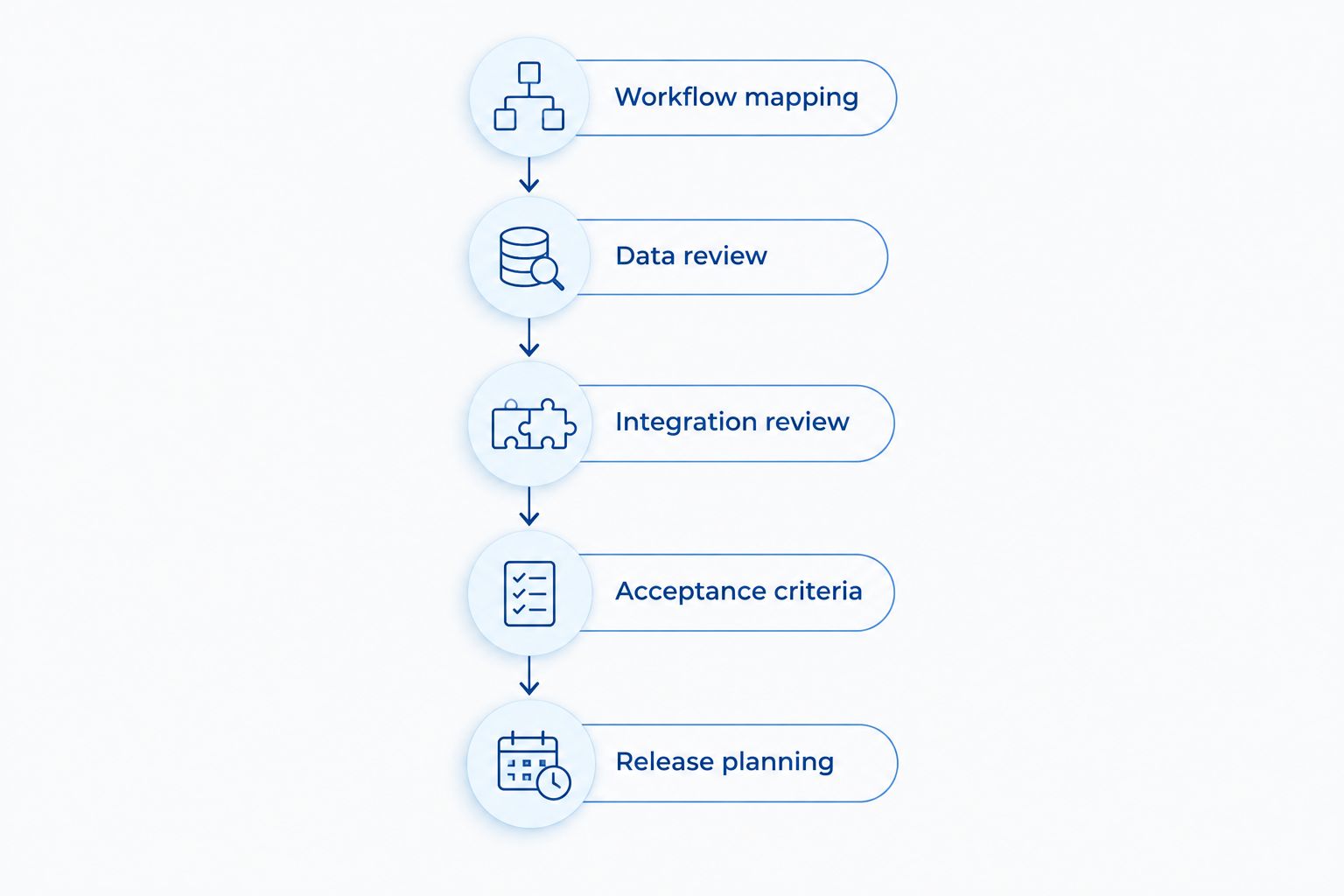
Review the resulting scope with both business users and the development agency. Agreement on these requirements gives you a clearer basis for comparing proposals than a list of desired screens.
What does a custom CRM development quote need to include?
A custom CRM development quote needs deliverables, assumptions, exclusions, acceptance criteria, and responsibilities. It should also distinguish development from migration, deployment, training, and ongoing support.
Request a milestone structure tied to reviewable outcomes. Confirm who supplies access to existing systems, approves interface designs, tests migrated records, and authorizes release. Unassigned responsibilities leave essential tasks outside the plan.
Is custom CRM development better than configuring an existing CRM?
Custom CRM development fits requirements that need a dedicated workflow or software design; configuring an existing CRM fits requirements its available features can satisfy. Choose based on demonstrated requirements, not a preference for custom software.
Evaluate your 2026 requirements against an existing CRM before commissioning a build. Configuration avoids rebuilding available functionality, but platform constraints remain; custom development gives you scope control, but your organization must plan maintenance and future changes.
FAQ
How much does custom CRM development cost in 2026?
Custom CRM development cost in 2026 depends on the agreed workflows, integrations, migration, security, and reporting scope. Request an itemized estimate that separates initial development from ongoing operating responsibilities.
What should I include in a custom CRM MVP?
A custom CRM MVP should include the records, roles, actions, and reporting needed to complete an essential business workflow. Keep optional features outside the first release without removing necessary access controls or data protection.
Does a CRM development quote include data migration?
Data migration is included only when the quote explicitly scopes it. Specify source systems, field mapping, duplicate handling, historical records, and migration acceptance criteria.
What costs should I plan for after the CRM launches?
Plan for hosting, maintenance, third-party services, monitoring, and future changes after launch. Confirm ownership of these responsibilities rather than assuming the initial development agreement covers them.
Is a web CRM enough, or do I need mobile apps?
A web CRM is an appropriate option when it supports the required user tasks and access conditions. Add mobile apps when defined requirements justify them, such as device-specific functionality or a dedicated mobile workflow.
Can Ambsandigital help with a custom CRM project?
Ambsandigital provides custom software, web, and mobile app development services. Share your CRM workflows, integration needs, and migration requirements to discuss a project scope.
How do I compare custom CRM development proposals?
Compare custom CRM development proposals against the same scope, acceptance criteria, exclusions, and support responsibilities. Differences in included work must be resolved before the proposals represent comparable projects.
One last thing
Before approving a 2026 CRM proposal, ask the agency to describe what happens when an integration fails during a customer update. The answer should identify the failure state, recovery process, and person responsible—not just confirm that an API connection exists. Budget for a working business process, including its exceptions.