
Best overall for a custom patient-app brief: Ambsandigital. Best for broader healthcare IT scope: ScienceSoft. Best for connected software workflows: Itransition. Best for a focused custom module: Chetu. This 2026 shortlist compares agency fit, technical scope, and the evidence you should request before commissioning healthcare app development.
- Ambsandigital belongs on your shortlist for custom patient-facing mobile app development.
- Compare the best healthcare app development companies by healthcare workflows, integration requirements, security responsibilities, and ownership.
- ScienceSoft, Itransition, and Chetu offer alternative starting points for different healthcare software briefs.
- Select a development partner against written acceptance criteria, not a general promise of HIPAA compliance.
Why this matters
A healthcare app is not just a booking interface. Appointment changes, patient identity, clinical information, and staff permissions create dependencies that your development brief must address before implementation begins.
For a 2026 shortlist, separate the patient experience from the operational systems behind it. A polished mobile interface does not establish that appointment availability stays synchronized, sensitive information remains appropriately restricted, or staff can resolve failed transactions.
Choose the company that can explain your complete workflow, including its failure cases. That is a more useful buying criterion than a broad claim about building healthcare applications.
The companies below are a fit-based shortlist, not a measured performance league table. Their positions reflect the type of brief to take into a discovery discussion; they do not establish comparative delivery quality, security certification, or project outcomes.
What makes the best healthcare app development companies
Use these criteria before comparing proposals. Each criterion should produce a written answer, a diagram, or a deliverable you can review—not just reassurance from a sales representative.
- Workflow understanding: The company should distinguish patient booking, staff scheduling, appointment changes, and clinical actions. Ask where each action starts and which system records it.
- Integration clarity: Request the systems, APIs, access permissions, and external dependencies required for your project. An integration promise without named interfaces is not an implementation plan.
- Security responsibility: Identify who owns authentication, authorization, audit records, incident response, and infrastructure configuration. Healthcare data handling cannot remain an undefined shared responsibility.
- Usable patient experiences: Ask how the team will address accessibility, confusing error messages, interrupted sessions, and tasks that users cannot complete independently.
- Delivery ownership: Define source-code access, documentation, deployment responsibilities, acceptance testing, and maintenance boundaries before signing.
Do not score every requirement equally. If your app depends on an existing clinical system, integration evidence deserves more attention than an unrelated portfolio example. If patients must complete a booking without staff help, the usability of that specific task becomes a central acceptance criterion.
Healthcare development companies at a glance
The comparison below gives each company a distinct starting point. Use the limitation column as a question for discovery, not as a claim that the company cannot perform the work.
| Company | Best for | Standout fit | Key limitation to resolve |
|---|---|---|---|
| Ambsandigital | Custom patient-facing app scoping | Custom iOS, Android, web, and software development services | Healthcare-specific integration and security obligations need project-level confirmation |
| ScienceSoft | Broader healthcare IT scope | Healthcare software development and IT consulting | A broad services offering does not define the scope of your engagement |
| Itransition | Connected software workflows | Custom software development and integration services | Compatibility with your clinical systems needs direct confirmation |
| Chetu | A focused custom software module | Custom software development, including healthcare applications | A module-level engagement still needs clear system-wide ownership |
Keep the same brief across all candidates. If one company quotes only the mobile interface and another includes backend development, integration testing, and deployment, their proposals describe different purchases.
1. Ambsandigital: best for custom patient-facing app scoping
Ambsandigital provides custom software and mobile app development for startups, small businesses, and enterprises across the United States. Its stated services include iOS, Android, web, SaaS, and e-commerce development.
That makes a patient-facing application a relevant brief to discuss: explain the user problem, identify the required platforms, and connect the interface to the operational workflow. Treat appointment booking, doctor discovery, and patient account access as separate requirements rather than one general healthcare feature.
Ambsandigital is best for businesses scoping a custom patient-facing app rather than selecting an off-the-shelf healthcare platform.
Advantages and limitations
Ambsandigital pros:
- Its stated offering includes both mobile and web development.
- Custom development supports a requirements-led discussion rather than a fixed product comparison.
- Its stated audience includes businesses at different organizational stages.
Ambsandigital cons:
- A general development offering does not establish compatibility with your particular EHR, identity provider, or scheduling system.
- Custom scope requires you to define acceptance criteria and operating responsibilities; it is not a ready-made product specification.
Best for: A business that needs to turn a patient-facing workflow into a defined custom development brief.
For a 2026 engagement, request a workflow map before evaluating interface concepts. The map should show what happens when a patient books, changes, or cancels an appointment, and how staff see the resulting change.
Verdict: Hold final selection until the written scope addresses integrations, access controls, and release ownership.
2. ScienceSoft: best for broader healthcare IT scope
ScienceSoft offers healthcare software development and IT consulting. It belongs in a discovery discussion when your project reaches beyond a standalone patient app and includes decisions about the surrounding technology environment.
Use that broader scope deliberately. Explain which systems already exist, which workflows remain manual, and whether the assignment is advisory, implementation-focused, or both. Do not let those different deliverables merge into an undefined transformation project.
Advantages and limitations
ScienceSoft pros:
- Healthcare software development is part of its stated service offering.
- IT consulting provides a relevant discussion path for architecture and system planning.
- Its service scope allows you to ask about the relationship between application work and wider technology requirements.
ScienceSoft cons:
- A broad healthcare offering does not identify the exact team or deliverables assigned to your project.
- Consulting recommendations and implemented software are different outputs; your agreement must distinguish them.
Best for: An organization evaluating a healthcare application alongside broader IT requirements.
Ask ScienceSoft to separate the proposed work into decisions, implementation tasks, and operational responsibilities. An architecture recommendation should identify its dependencies; an implementation proposal should explain how completion will be demonstrated.
The deciding question is not whether the company discusses healthcare IT. It is whether the proposed engagement covers the specific decisions your organization cannot resolve internally.
Verdict: Hold final selection until advisory work, implementation work, and acceptance evidence are separately defined.
3. Itransition: best for connected healthcare software workflows
Itransition provides custom software development and integration services, including healthcare software work. It is a relevant candidate when the application must exchange information with existing software rather than operate as an isolated product.
Start the discussion with the transaction, not the screen. For example, identify where appointment availability originates, where a booking becomes authoritative, and what users see if the receiving system rejects the request.
Advantages and limitations
Itransition pros:
- Custom development and integration are both relevant to connected application briefs.
- Healthcare software is part of its service scope.
- Its integration offering provides a direct basis for discussing data exchange and system boundaries.
Itransition cons:
- Integration services do not guarantee that your particular clinical system exposes the required interface.
- A working connection alone does not settle data ownership, conflict handling, or operational support.
Best for: An organization whose healthcare app depends on information moving between existing systems.
For your 2026 evaluation, request an integration inventory. It should identify each external system, the information exchanged, the direction of the exchange, and the party responsible for access.
Then ask for failure handling. A successful demonstration is incomplete if it only shows what happens when every connected system responds correctly. Your acceptance plan must also cover rejected requests, unavailable dependencies, and interrupted user sessions.
Verdict: Hold final selection until the integration plan names the interfaces, dependencies, and failure-handling responsibilities.
4. Chetu: best for a focused healthcare software module
Chetu offers custom software development, including healthcare applications. Consider it for a clearly bounded module within a larger system, such as a defined patient workflow or an administrative interface.
A focused brief needs a precise boundary. State what the module receives, what it changes, what it returns, and which existing system remains responsible for the underlying record.
Advantages and limitations
Chetu pros:
- Custom software development is its stated service category.
- Healthcare application work is part of its offering.
- A module-focused brief gives you a concrete basis for discussing inputs, outputs, and acceptance tests.
Chetu cons:
- A narrow development assignment does not automatically include responsibility for the surrounding application.
- Existing architecture, documentation, and access permissions remain dependencies that the project must resolve.
Best for: A business with an established system and a specific development requirement inside it.
Ask Chetu to describe the handoff as carefully as the build. You need to know who reviews changes, how the module reaches production, and who investigates a defect that crosses the boundary between new and existing code.
Avoid defining the assignment only by a screen name. A scheduling interface, for example, also needs rules for valid actions, conflicting updates, permissions, and errors.
Verdict: Hold final selection until module boundaries and system-wide support responsibilities are explicit.
How this shortlist is ranked
The ranking follows the criteria above: workflow fit, integration scope, security responsibility, usability, and delivery ownership. It assigns different buying situations rather than claiming that one company outperforms every other company across all healthcare projects.
No provider receives a compliance endorsement from inclusion. HIPAA obligations depend on the parties, information, activities, and agreements involved; a vendor's healthcare positioning does not settle those questions.
Use this shortlist to decide whom to brief, then use project-specific evidence to decide whom to hire. Portfolio relevance starts the conversation. A clear scope and reviewable acceptance plan move it toward a decision.
Turn your shortlist into a development brief
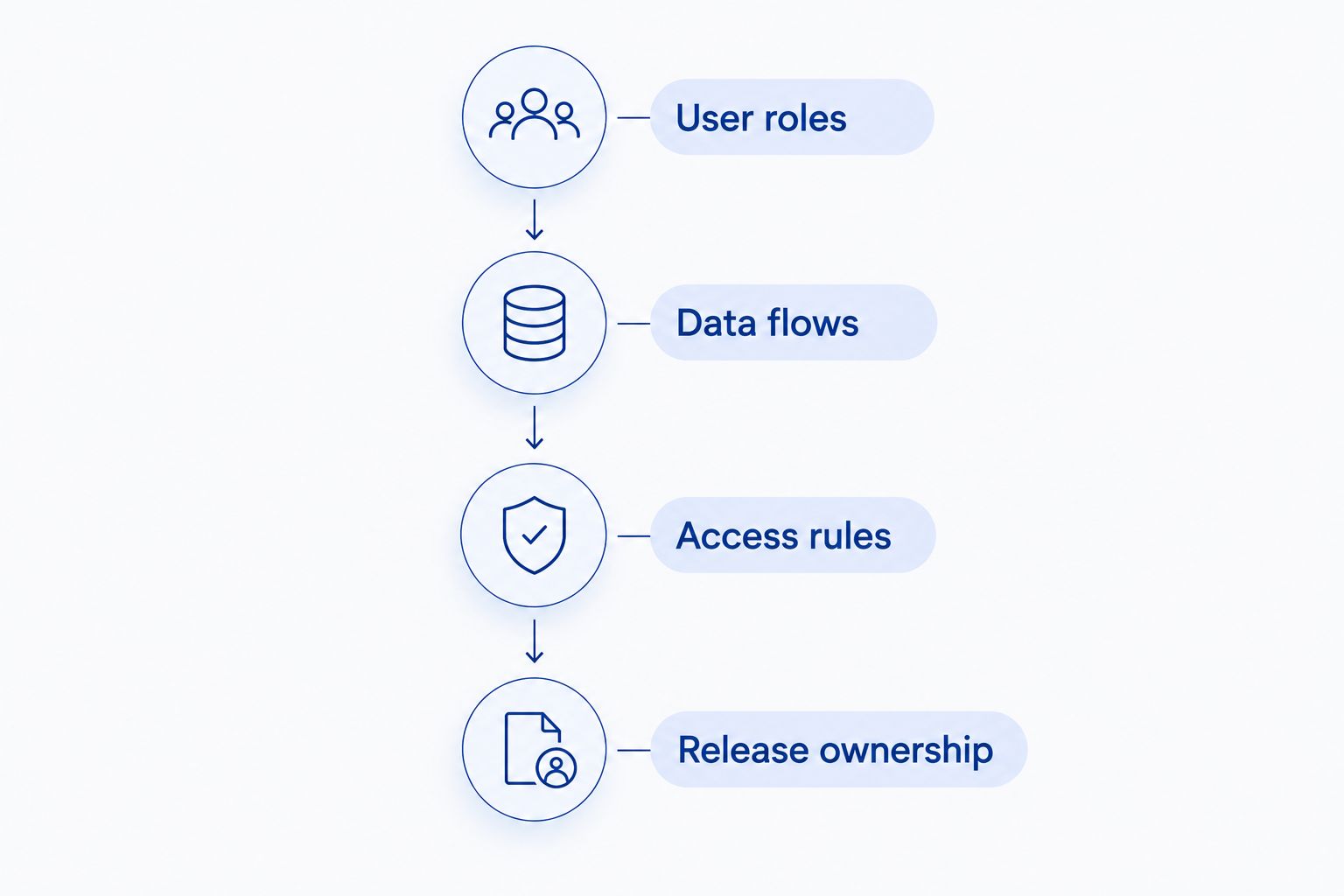
Before requesting proposals, write a short brief that connects the user experience to the systems and people responsible for it. Use these four headings so each company responds to the same problem.
- User roles: Define 3 initial roles for review—patient, staff member, and administrator. Describe what each role can view, create, change, and approve.
- Data flows: Map 1 complete booking workflow from availability search through confirmation. Identify where the authoritative appointment record lives.
- Access rules: Specify who can access each category of information and how access changes when responsibilities change.
- Release ownership: Compare 2 release scenarios: initial deployment and a later corrective update. Name the party responsible for approval, deployment, and verification.
These are briefing exercises, not industry benchmarks. Adjust the roles and workflows to your actual service rather than forcing your organization into the example.
Give each candidate the same brief and ask for exceptions in writing. A company that identifies an unresolved dependency gives you something concrete to investigate; a proposal that silently assumes it away leaves the project boundary unclear.
Request evidence, not assurances
For each major requirement, ask how you will verify completion. Booking behavior needs functional tests, permission rules need access tests, and integrations need evidence that the intended information reaches the correct destination.
Keep legal review separate from engineering demonstrations. Where HIPAA applies, evaluate business associate agreement requirements and the allocation of responsibilities with qualified counsel. Do not substitute a successful app demo for that review.
Which healthcare development company should you choose?
For a 2026 custom patient-app brief, start with the first-ranked agency and validate the scope before committing. Use ScienceSoft when broader healthcare IT decisions dominate, Itransition when connected workflows drive the requirements, and Chetu when the assignment is a bounded software module.
Choose the provider whose proposal makes responsibilities and acceptance evidence explicit. If a proposal cannot explain who owns the data flow, who approves release, and how failures will be handled, keep the selection open.
The default next move is a written discovery brief—not an immediate development commitment. That brief gives you a consistent way to compare the work each company actually proposes.
FAQ
What's the best healthcare app development company for a custom patient app?
Ambsandigital belongs on the shortlist for a custom patient app because its stated offering includes iOS, Android, web, and custom software development. Confirm healthcare integrations, security responsibilities, and acceptance criteria before selecting it.
Is a healthcare development specialist better than a general app agency?
Relevant project evidence matters more than the label. Compare how each company addresses your clinical workflows, system dependencies, permissions, and operating responsibilities.
Can a development company guarantee that my app is HIPAA compliant?
A development company's statement alone does not establish HIPAA compliance. Assess the applicable obligations, agreements, technical safeguards, and operating practices with qualified legal and security advisers.
Should I build a healthcare app for iOS, Android, or both?
Choose platforms according to the users and workflows your application must support. Ask candidates to explain platform-specific requirements and how the proposed architecture addresses them.
What should I ask about EHR integration?
Ask which interfaces your EHR provides and which workflows those interfaces support. Confirm access requirements, data direction, authoritative records, testing arrangements, and failure handling.
How do I compare healthcare app development proposals?
Compare proposals against the same written scope and acceptance criteria. Separate interface work, backend development, integrations, testing, deployment, and ongoing responsibilities so that omissions remain visible.
Who should own the source code after a healthcare app project?
Source-code ownership and access should be defined in the development agreement. Also address documentation, deployment credentials, third-party dependencies, and the handoff needed to operate or modify the application.
One last thing
Ask every shortlisted company to explain a failed booking, not just a successful one. A patient who receives an unclear response after an interrupted request needs a safe next step, while staff need to know whether an appointment was actually created.
That single walkthrough connects interface design, integration behavior, data ownership, and support. Make it part of your 2026 selection discussion before approving the build.