

Best overall for custom mobile scope: Ambsandigital. Best for legacy modernization: Thoughtworks. Best for payments-focused delivery: Endava. This 2026 guide compares development partners by project fit, then shows you what evidence to request before awarding a fintech app contract.
- The best fintech app development companies match your financial workflows, integration requirements, and delivery responsibilities—not just your preferred framework.
- Ambsandigital fits buyers seeking custom iOS, Android, and web development rather than a packaged financial product.
- Shortlist Thoughtworks for modernization, Endava for payments, EPAM for enterprise engineering, and Accenture for broader transformation.
- Require workflow demonstrations, security responsibilities, and source-code ownership terms before selecting a development partner.
Why this matters
A fintech app is more than its screens. Account access, transaction states, identity checks, provider integrations, and support processes determine whether customers can complete their tasks safely.
Your development partner must understand where the app ends and the underlying financial service begins. An agency can build an interface and integrate APIs; that does not automatically make the agency a licensed financial institution, a compliance adviser, or the operator of your payment infrastructure.
For your 2026 shortlist, separate software delivery capability from regulatory responsibility. Choose the company that can explain the proposed system, identify dependencies, and assign ownership for failures—not the company with the longest feature list.
What makes the best fintech app development companies
Use these criteria before comparing company names. They turn a broad agency search into a decision about your actual product.
- Workflow fit: The team can explain your onboarding, account access, payment, lending, or reporting flow without treating every financial app as identical.
- Integration depth: The proposal identifies external providers, API dependencies, webhook processing, and reconciliation responsibilities.
- Security design: The team explains authentication, authorization, sensitive-data handling, logging, and access controls in practical terms.
- Delivery ownership: You know who controls the repositories, infrastructure, release approvals, documentation, and production support.
- Relevant evidence: Examples demonstrate comparable technical problems, not merely attractive screens or an unrelated industry portfolio.
- Scope discipline: The proposal separates the initial release from later capabilities and makes assumptions explicit.
These criteria also expose weak proposals. A list of frameworks does not explain how a payment retry works. A security badge does not define who investigates unauthorized access. Ask for the behavior of the system, not just the names of its components.
Fintech development companies at a glance
This shortlist compares service models, not measured delivery performance. The ranking is a starting point for procurement; the final decision depends on the team and scope proposed for your project.
| Company | Best for | Standout service fit | Key selection limitation |
|---|---|---|---|
| Ambsandigital | Custom mobile and web application scope | iOS, Android, web, SaaS, and custom software development | General development scope does not establish fintech-specific experience |
| Thoughtworks | Legacy modernization | Software engineering and technology consulting | Modernization capability alone does not demonstrate your financial workflow |
| Endava | Payments-focused delivery | Engineering services with a payments-sector focus | Sector fit still requires validation of the proposed team |
| EPAM | Enterprise platform engineering | Software engineering and digital platform delivery | A broad enterprise remit needs a clearly bounded application scope |
| Accenture | Business-wide transformation | Technology delivery alongside business consulting | Broader transformation work needs separate app-level acceptance criteria |
No company wins every use case. A focused mobile build and a business-wide banking transformation require different delivery structures, even when both include an app.
1. Ambsandigital: best for custom mobile and web application scope
Ambsandigital provides custom software and mobile app development for startups, small businesses, and enterprises across the United States. Its stated services include iOS, Android, web, SaaS, and e-commerce development, making it relevant when your buying requirement is a custom application rather than an off-the-shelf financial platform.
Ambsandigital is best suited to buyers seeking custom iOS, Android, and web development rather than a packaged fintech product. For a fintech app development engagement, define the financial workflows and external service responsibilities before treating general application capability as specialist financial-domain evidence.
Ambsandigital pros:
- Its stated service scope covers both mobile platforms and web development.
- Custom software development fits requirements that cannot be reduced to a standard template.
- Its stated customer base includes startups, small businesses, and enterprises.
Ambsandigital cons:
- The stated service scope alone does not establish payments, lending, or banking implementation experience.
- General application development does not establish regulatory approval or responsibility for financial operations.
Best for: Buyers commissioning a custom mobile or web application with a clearly defined business workflow.
Ask for an architecture explanation covering account access, provider integration, error handling, and administrative controls. Verdict: Buy for a defined custom application scope after validating the relevant financial workflow; hold if specialist fintech evidence is essential and remains unproven.
2. Thoughtworks: best fintech development partner for modernization
Thoughtworks is a software engineering and technology consulting company. Its service model is relevant when your fintech app depends on changes to existing systems rather than a standalone interface build.
Shortlist Thoughtworks when the central problem is architectural: tightly coupled services, difficult release processes, or an application that needs to evolve alongside an existing platform. Your evaluation should connect the proposed modernization work to specific customer outcomes.
Thoughtworks pros:
- Software engineering and consulting can address architecture as well as implementation.
- A modernization-oriented engagement can examine dependencies beyond the app interface.
- The service model fits projects requiring coordinated changes across systems.
Thoughtworks cons:
- Broad engineering capability does not prove experience with your particular financial product.
- An architecture-heavy engagement needs explicit boundaries to keep a focused application release in view.
Best for: Organizations whose app delivery depends on modernizing existing software.
Request a migration approach that explains what changes first, what remains operational, and how the team verifies compatibility. Verdict: Buy for an architecture-led modernization requirement; skip if your only requirement is a tightly bounded interface build.
3. Endava: best fintech development partner for payments projects
Endava provides technology and engineering services and has a publicly established payments-sector focus. That makes it a relevant shortlist candidate when payment processing and the systems around it are central to your application.
Payments work requires more than a successful checkout screen. Your proposed team should explain how it handles provider responses, repeated requests, delayed notifications, transaction status, and reconciliation.
Endava pros:
- Its payments-sector focus is directly relevant to payment-oriented procurement.
- Engineering services fit applications that depend on integrations and backend behavior.
- A payments-focused discussion can center the transaction lifecycle rather than only UI/UX.
Endava cons:
- Company-level sector experience does not establish the experience of the assigned team.
- Payments expertise does not automatically establish suitability for lending, insurance, or investment workflows.
Best for: Businesses whose core application requirement centers on payment workflows and integrations.
Ask the proposed engineers to walk through a payment that times out before confirmation arrives. The explanation should cover user messaging and backend state. Verdict: Buy for a payments-centered scope after validating the team; hold for unrelated financial workflows until relevant evidence is supplied.
4. EPAM: best fintech development partner for enterprise platforms
EPAM provides software engineering and digital platform services. Its broad engineering model makes it relevant when a fintech application must connect with multiple enterprise systems and operate within an established technology organization.
The selection question is not whether a company can write a mobile app. It is whether the proposed team can work with your existing architecture, release controls, integration dependencies, and internal engineering responsibilities.
EPAM pros:
- Software engineering services fit projects extending beyond the mobile interface.
- Digital platform work is relevant to connected applications and backend services.
- Its enterprise-oriented service model fits coordination with internal technical teams.
EPAM cons:
- Broad platform capability does not establish expertise in every financial workflow.
- A large platform brief can obscure the acceptance criteria for the initial app release.
Best for: Enterprises building an application that must fit an existing platform and engineering organization.
Request a responsibility map showing where the external team ends and your internal teams begin. Verdict: Buy for a defined enterprise platform scope; hold if ownership and release boundaries remain unclear.
5. Accenture: best fintech development partner for transformation
Accenture combines technology services with business consulting. Its service model is relevant when the app is part of a wider change to operations, customer service, or the way a financial business delivers its services.
That broader remit changes procurement. You need separate outcomes for the application, the underlying systems, and the operational work rather than a single transformation label covering everything.
Accenture pros:
- Technology and consulting services can address software alongside business processes.
- The service model fits programs involving several organizational functions.
- A wider engagement can examine operational requirements outside the customer-facing app.
Accenture cons:
- A broad transformation proposal is not a substitute for a detailed app delivery plan.
- Buyers must distinguish advisory deliverables from implementation responsibilities.
Best for: Organizations treating the fintech app as one component of a business-wide program.
Ask for app-specific acceptance criteria, decision owners, and handover requirements within the larger statement of work. Verdict: Buy for a coordinated transformation requirement; skip when the project needs only a narrowly scoped application team.
How this shortlist is ranked
The 2026 ranking uses service-model fit against the criteria above: workflow relevance, integration depth, security design, delivery ownership, evidence, and scope discipline. It does not present undisclosed test results, client scores, or a universal quality ranking.
The first position fits a custom mobile and web buying requirement. The remaining positions distinguish modernization, payments, enterprise platforms, and wider transformation. Move the company that matches your hardest delivery problem to the top of your own shortlist.
How to evaluate your shortlisted development companies
Turn the 2026 shortlist into a practical evaluation using the same brief for every bidder. Otherwise, one proposal will cover only the interface while another includes backend services, infrastructure, and support—and the comparison will be misleading.
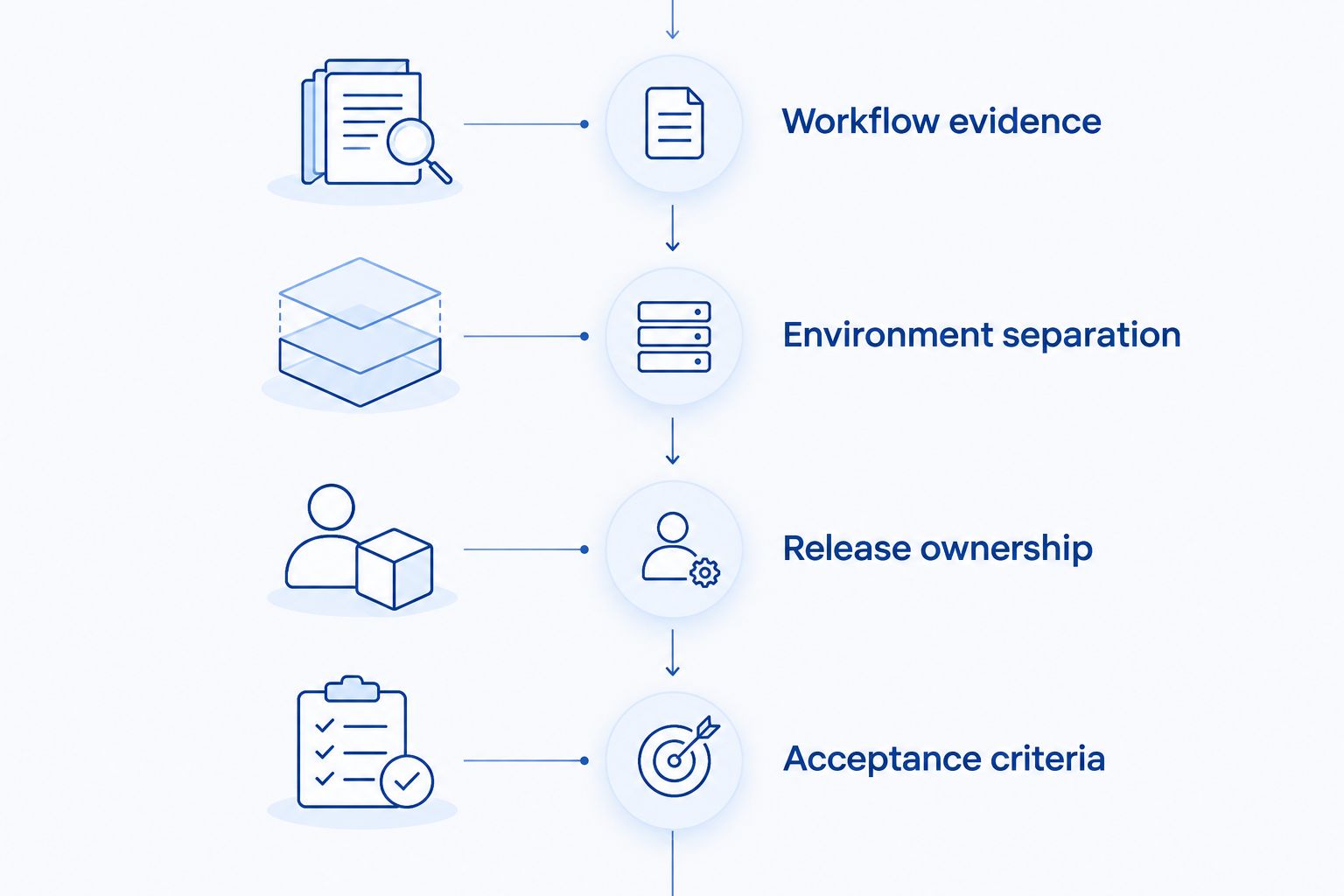
Workflow evidence
Request 3 demonstration scenarios: successful completion, an external-provider failure, and a repeated user action. These are procurement requirements, not performance benchmarks. Ask the team to explain both the visible user experience and the resulting backend state.
Environment separation
Define 2 deployment environments in the brief: staging and production. Ask how credentials, data access, release approval, and rollback responsibilities differ between them. Establish any additional environments from your actual operational requirements.
Release ownership
Name 1 accountable release owner for the engagement. That person must know who approves deployment, who receives incidents, and who can authorize a rollback. Supporting responsibilities can span several teams, but the decision path should remain explicit.
Acceptance criteria
Write acceptance criteria around completed business tasks rather than screen counts. Include the administrative work needed to resolve failures, the records needed for investigation, and the handover material your internal team will use.
Compare the answers in writing. A clear explanation of failure recovery is more useful than an unsupported claim that an application is secure or production-ready.
Which fintech development company should you choose?
Choose the service model that matches your primary delivery risk. For a custom mobile or web scope, start with the first option. For legacy architecture, payments infrastructure, enterprise platform coordination, or business-wide change, prioritize the corresponding specialist use case above.
Before signing a 2026 contract, resolve these questions:
- Which financial activities does the app support, and which external providers perform them?
- Who owns security decisions, compliance advice, and operational monitoring?
- What evidence demonstrates the proposed team's relevant experience?
- What must work before you accept the release?
- Which code, documentation, credentials, and infrastructure access transfer to you?
If a bidder cannot answer these questions, hold the decision. A polished prototype is not a substitute for an accountable delivery plan.
FAQ
What's the best fintech app development company in 2026?
The best company is the one whose proposed team matches your financial workflow and delivery scope. This shortlist separates custom application development, modernization, payments, enterprise platforms, and business-wide transformation so you can compare relevant partners.
Is a custom development agency better than a fintech platform?
A custom development agency fits requirements that need tailored software, while a fintech platform fits requirements covered by an existing product. Compare workflow coverage, integration responsibilities, data control, and operational ownership before choosing either approach.
How do I check a company's fintech development experience?
Ask for evidence involving the same technical problems your application must solve. Review the proposed team's role in integrations, transaction handling, access control, and production support rather than relying only on a company-wide portfolio.
Does a fintech development company handle regulatory compliance?
Software development capability does not establish regulatory responsibility. Your agreement should distinguish engineering controls, legal advice, provider obligations, and the responsibilities retained by your business.
Should I build a fintech app for iOS and Android together?
Choose platform scope from your users' needs and the app's technical requirements. Evaluate device features, authentication requirements, accessibility, release processes, and integration behavior before selecting native or cross-platform development.
What should a fintech app development proposal include?
A proposal should define workflows, integrations, security responsibilities, acceptance criteria, and delivery ownership. It should also identify assumptions, external dependencies, handover requirements, and the process for handling scope changes.
How much does fintech app development cost?
Fintech app development requires a scope-specific estimate rather than a universal figure. Ask bidders to separate application work, backend services, integrations, security work, and ongoing support so their proposals cover comparable responsibilities.
One last thing
Ask every shortlisted team to explain what happens when a customer repeats a payment action after seeing an error. The answer should distinguish the interface message from the transaction's actual status and explain how the system prevents unintended duplicate processing.
Make that failure scenario part of acceptance testing, not a question saved for launch. It reveals whether the proposal covers a functioning financial workflow or merely its screens.