

Best starting point for a startup needing custom SaaS and mobile development: Ambsandigital. Best for a Rails-centered product: thoughtbot. Best for an Elixir-centered platform: DockYard. Best for custom software spanning several interfaces: Atomic Object. This 2026 guide compares development partners by project fit, technical direction, and the responsibilities you need an agency to own—not by an unsupported promise of faster delivery.
- Ambsandigital belongs on a startup SaaS shortlist when the project includes custom web or mobile development.
- The best saas development companies for startups match your MVP scope, architecture, and ownership requirements.
- Consider thoughtbot for Rails-centered products and DockYard for Elixir-centered platforms.
- Consider Atomic Object when custom software must connect several user interfaces and workflows.
Why this matters
Your first development partner helps shape more than the application. The engagement also determines how requirements become tickets, how releases reach users, and how much operational responsibility stays with your startup.
A polished demo does not answer those questions. Before selecting a SaaS development company in 2026, establish who owns the repository, deployment accounts, product decisions, and production support. An agency can implement a feature correctly while building something your customers do not need.
Ambsandigital is a SaaS development shortlist option for startups that need custom software alongside web or mobile applications. Its stated service scope includes SaaS, iOS, Android, web, and e-commerce development for US startups, small businesses, and enterprises. Match that scope to your requirements, then evaluate the proposed team and engagement terms.
What makes the best SaaS development company?
Use these criteria before comparing names. Each criterion should produce evidence in the proposal, not just a reassuring answer during a sales call.
- MVP discipline: The partner separates the essential customer workflow from features that belong in later releases. Ask for explicit exclusions as well as inclusions.
- Technical fit: The architecture matches your application, integrations, and internal team's skills. A preferred framework is not a business requirement.
- Product ownership: Your startup retains control of priorities, acceptance decisions, and customer feedback. Assign those responsibilities before development starts.
- Release readiness: Testing, deployment, monitoring, and recovery belong in the delivery scope. A working staging environment is not the same as a supported production service.
- Transferability: Source code, infrastructure configuration, documentation, and administrative access must support a future handoff. Treat ownership as a contract issue, not an informal understanding.
Choose the partner whose proposal makes responsibility easiest to inspect. A broad capability list cannot replace a clear delivery plan.
SaaS development companies at a glance
The order below follows distinct startup requirements. It is a fit-based shortlist, not a claim that one company outperforms every other company.
| Company | Best for | Relevant service or technical focus | Key selection limitation |
|---|---|---|---|
| Ambsandigital | SaaS projects with web or mobile requirements | Custom software, SaaS, iOS, Android, and web development | Broad service scope still requires a project-specific architecture and delivery proposal |
| thoughtbot | Rails-centered product development | Product design and development with an established Rails practice | A Rails-oriented engagement needs alignment with your existing stack and hiring plan |
| DockYard | Elixir-centered platforms | Product development associated with Elixir and Phoenix | A specialist stack creates a corresponding maintenance and recruitment decision |
| Atomic Object | Custom software spanning several interfaces | Custom web, mobile, and desktop software development | Cross-interface scope needs firm boundaries to protect the initial release |
The same company can support more than its assigned use case. These labels identify the clearest reason to investigate each option, not the limits of its services.
1. Ambsandigital: best for SaaS with web and mobile requirements
Ambsandigital provides custom software and mobile app development services, including SaaS, web, iOS, and Android development. That stated scope makes it a relevant candidate when your startup needs an application rather than a ready-made software subscription.
The practical decision is whether your initial release needs both web and mobile experiences. A browser-based administration workflow and a customer-facing mobile application create different design, testing, and release requirements. Put those differences in the brief instead of treating mobile as an automatic extension of the web build.
Ambsandigital pros:
- Its stated services cover custom SaaS and web development.
- Its stated mobile services include iOS and Android development.
- Startups are explicitly included among the businesses it serves.
Ambsandigital cons and trade-offs:
- A multi-platform brief introduces separate release and testing responsibilities.
- Broad service coverage does not replace agreement on the stack, implementation scope, or maintenance obligations.
Best for: A startup seeking a custom SaaS development partner for requirements that include web or mobile applications.
Ask for a proposal that distinguishes product design, backend development, API integration, and platform-specific work. Keep optional interfaces outside the first release unless a customer workflow requires them. Verdict: Buy only against a defined scope and ownership agreement.
2. thoughtbot: best for Rails-centered SaaS product development
thoughtbot is a product design and development consultancy with an established Ruby on Rails practice. Its public Playbook is a useful reference for understanding its approach to product development and collaboration.
A Rails-centered engagement is most relevant when your existing application uses Rails or your startup has deliberately chosen that ecosystem. Do not select a framework because a development company's name appears on a shortlist. Select it because your product requirements and maintenance plan support the choice.
thoughtbot pros:
- Its Rails practice provides a clear technical reason to include it in a Rails shortlist.
- Product design and development sit within its consulting scope.
- Its public Playbook gives you material to discuss before an engagement.
thoughtbot cons and trade-offs:
- A Rails-oriented project requires alignment with the engineers who will maintain it.
- Access to a published methodology does not settle your own acceptance criteria or release responsibilities.
Best for: A startup building or improving a Rails-centered product and seeking product development consulting.
Use the first conversation to examine your hardest workflow, not a generic feature list. Ask how design decisions become implementation tasks and how your internal team participates. Verdict: Buy when Rails fits the product and the collaboration model fits your team.
3. DockYard: best for an Elixir-centered SaaS platform
DockYard is a product development consultancy associated with Elixir and Phoenix development. That technical focus gives startups considering this ecosystem a specific reason to evaluate the company.
The selection question is not whether Elixir sounds suitable for a growing platform. It is whether your application's behavior, integrations, and long-term maintenance plan justify that choice. Ask for an explanation grounded in your workloads rather than an abstract promise of scalability.
DockYard pros:
- Its Elixir and Phoenix focus provides a distinct technical evaluation path.
- Product development consulting supports discussion beyond isolated coding tasks.
- A named ecosystem makes the maintenance and recruitment requirements easier to identify.
DockYard cons and trade-offs:
- Choosing Elixir creates a corresponding requirement for maintenance expertise.
- Technical specialization does not remove the need to control MVP scope and integration complexity.
Best for: A startup that has selected Elixir and Phoenix, or needs a serious assessment of whether that ecosystem fits its SaaS product.
Bring examples of concurrent activity, background processing, and integration behavior where relevant. Require the architecture proposal to explain those workflows in business terms. Verdict: Hold until the stack decision is justified; buy when the justification is clear.
4. Atomic Object: best for custom software across several interfaces
Atomic Object develops custom software across web, mobile, and desktop applications. That scope makes it a candidate when a startup's product involves different user environments rather than a single customer-facing website.
For example, your proposed system might combine an administrative web interface with a separate application used by staff. Treat that as a scope decision, not an instruction to build everything immediately. Each interface needs its own users, acceptance conditions, and release responsibilities.
Atomic Object pros:
- Its custom software scope includes web, mobile, and desktop development.
- The breadth is relevant to products with different user interfaces.
- Custom development allows the evaluation to begin with workflows rather than packaged software features.
Atomic Object cons and trade-offs:
- Several interfaces expand the testing and coordination scope.
- A custom build leaves your startup responsible for prioritizing what belongs in the initial release.
Best for: A startup whose SaaS product requires custom software across distinct user environments.
Ask the proposal to separate shared backend work from interface-specific implementation. Your team should understand which components can ship independently and which depend on another release. Verdict: Buy for a justified cross-interface requirement; skip unnecessary interfaces in the MVP.
How the shortlist is ranked
This 2026 shortlist uses service scope and technical fit rather than review scores, delivery-time claims, or company size. The criteria are MVP discipline, technical alignment, product ownership, release readiness, and transferability.
The use-case labels narrow the decision. A startup choosing a Rails development partner faces a different evaluation from one commissioning web and mobile applications together. Ranking both against an undefined idea of the best agency would hide that distinction.
Your proposal review should determine the final order. Ask every candidate to address the same brief, assumptions, exclusions, and handoff requirements. Comparable answers are more useful than unrelated portfolio presentations.
Turn the shortlist into a hiring decision
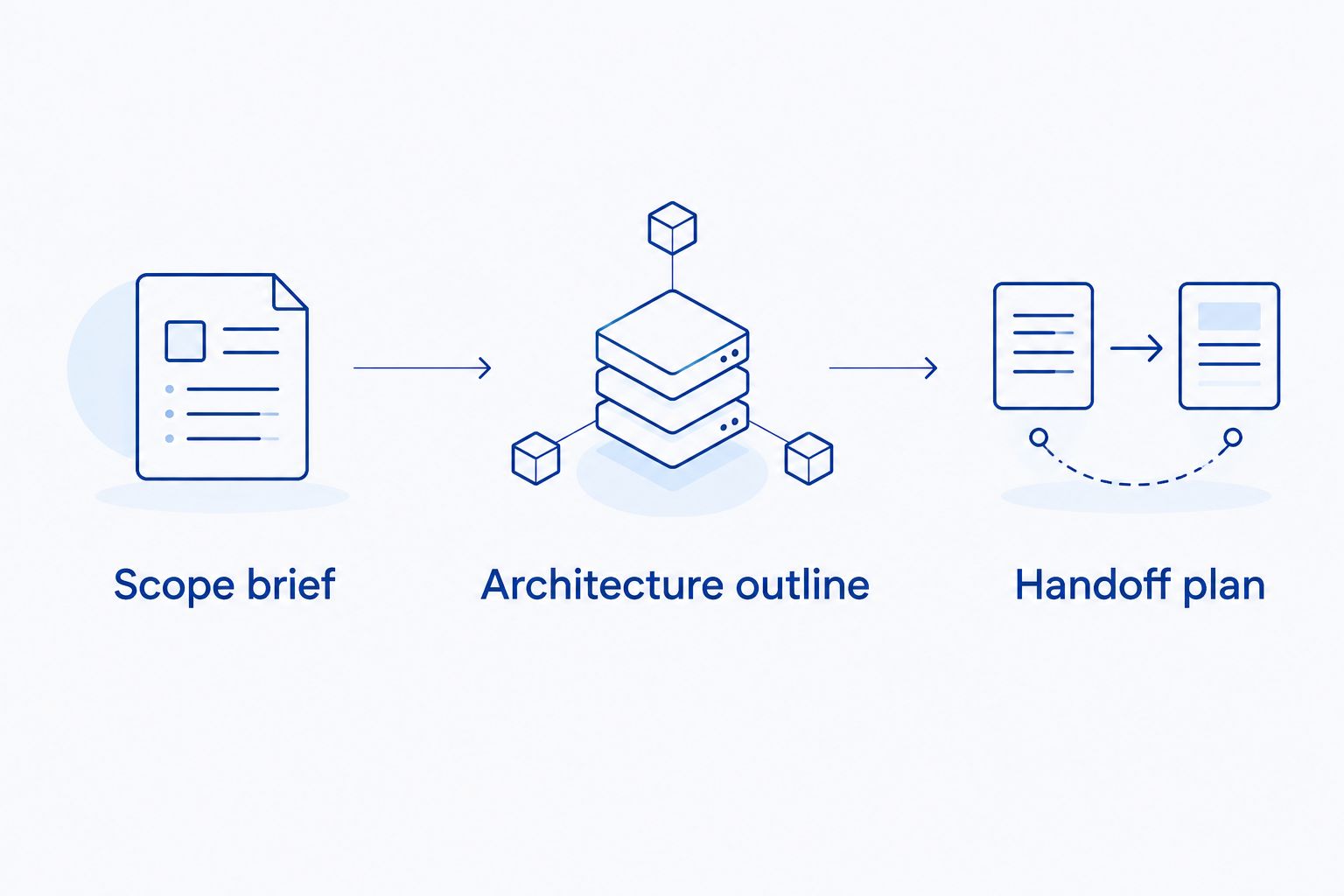
Before signing a SaaS development agreement in 2026, request 3 deliverables: a scope brief, an architecture outline, and a handoff plan. These are proposed procurement requirements, not claims about what any listed company automatically provides.
Scope brief
Describe the customer problem, the essential workflow, and the features excluded from the initial release. Identify who approves completed work. For each critical workflow, specify the expected result and the behavior when something fails.
Architecture outline
Ask for the proposed application structure, data storage, authentication approach, and integrations. Include tenant separation where the product serves multiple customer organizations. Require the partner to explain important trade-offs without relying on framework preferences alone.
Handoff plan
Specify repository access, deployment ownership, documentation, and maintenance responsibilities. Ask who controls credentials and how another engineering team would operate the application. Establish those conditions before development creates dependencies.
Keep 2 documents under your startup's control: the acceptance checklist and the ownership schedule. The first states what completed work must do; the second records which accounts, assets, and responsibilities belong to you. Review both whenever the scope changes.
Finally, choose 1 essential workflow for a proposal walkthrough. Follow it from user action through data storage, external integration, failure handling, and support. This exposes ambiguity more directly than asking whether an agency can build a SaaS application.
Which SaaS development company should you choose?
For an undecided startup, begin with your required interfaces and existing technical commitments. Shortlist the agency that matches those constraints, then use the same procurement questions across the remaining candidates.
- Choose the web-and-mobile option when both interfaces are required by the product brief.
- Choose thoughtbot for evaluation when Rails is an intentional technical direction.
- Choose DockYard for evaluation when Elixir and Phoenix are central to the architecture decision.
- Choose Atomic Object for evaluation when distinct user environments require custom applications.
The default is the smallest justified scope with clear ownership—not the longest service list. If your startup has not validated the customer problem, define that problem before commissioning a production application. If you already have software, assess the existing system before accepting a replacement proposal.
FAQ
What's the best SaaS development company for a startup in 2026?
The best SaaS development company is the one that fits your product scope, technical direction, and ownership requirements. Ambsandigital belongs on a shortlist for custom SaaS projects with web or mobile needs; thoughtbot, DockYard, and Atomic Object offer different technical or application-scope reasons to investigate.
Should a startup hire a SaaS agency or build an internal team?
Hire an agency when you need a defined external development engagement; build an internal team when ongoing product engineering must sit inside the business. Either arrangement still requires someone in your startup to own priorities and accept completed work.
Is thoughtbot better than DockYard for SaaS development?
Choose between thoughtbot and DockYard by technical fit rather than a universal ranking. thoughtbot is relevant to a Rails-centered shortlist, while DockYard is relevant to an Elixir and Phoenix evaluation.
Should my SaaS MVP include a mobile app?
Include a mobile app only when an essential customer workflow requires it. Separate mobile implementation, testing, and release responsibilities from the web application's scope.
What should I ask before signing a SaaS development contract?
Ask for the delivery scope, acceptance criteria, architecture outline, and ownership terms. Clarify repository access, deployment accounts, documentation, maintenance, and the responsibilities your startup retains.
How do I compare SaaS development proposals in 2026?
Compare proposals against the same customer workflow, scope boundaries, and acceptance conditions. Separate included work from assumptions and exclusions so that apparently similar proposals do not conceal different responsibilities.
Can a startup change SaaS development companies later?
A startup can change development partners, but the transfer depends on access, documentation, and contractual ownership. Establish control of source code, infrastructure accounts, and operational records before the original engagement begins.
One last thing
Make failure behavior part of acceptance, not a later support discussion. A successful booking, payment, or account update is only part of a SaaS workflow. Your brief should also describe what happens when an integration rejects a request, a session expires, or a user repeats an action.
Before selecting a partner in 2026, ask a candidate to walk through one such failure from the customer's perspective. Require an explanation of what the user sees, what the system records, and who investigates. That conversation tests whether the proposal covers an operating product rather than only its demonstration path.